One of the things that I missed the most during covid and the local quarantines were the face-to-face events on technology. That’s why 2022 was a great opportunity to return to that events such as Eth Latam, ETH Denver, Devcon and LaBitconf. Last month I was recording this podcast with Pablo Sabbatella and one of the topics was the upcoming events for the rest of the year. I’ve selected these 5 that I think you might be interested in based on my own experience, events I attended, and recommendations from attendees.
EthCC 6
Devconnect
Here I cheated, because it is not a conference in itself but a week of activities. Since we are not going to have a Devcon this year, I think it is a great opportunity to connect with other devs and know many projects in the web3 universe. Recommended if you are interested in networking.
An event that is part of the Eth Global hackathon series, but in an iconic city. If you have an idea and want to receive financing, this is a great opportunity. Plus, there’s the chance to learn and network. Recommended for developers who want to make their project a reality.
Great opportunity for Latin America, especially those of us further south. There will be many experts and activities and much of the content in Spanish. Recommended for developers in Latam.
If you don’t have the resources to attend an event in person, you can apply to this hackathon, which is 100% remote. Although the richness of face-to-face is lost, the comfort of being at home may increase productivity and ideas. Recommended for those who can’t travel.
Are you going to participate in any of these events? Did you participate in ETH Denver? Will you attend any other event that is not listed? Leave a comment !
We are always looking for Web3 talent !
Mighty Block is one of the partners of Forte, a platform to enable game publishers to easily integrate blockchain technologies into their games. We believe blockchain will enable new economic and creative opportunities for gamers around the world and have assembled a team of proven veterans from across the industry (Kabam, Unity, GarageGames, ngmoco, Twitch, Disney), as well as a $100M developer fund & $725M funding, to help make it happen. That’s where you come into play.
Feel free to browse all our current open job opportunities in the following link 👇
As you may know, Ethereum is the leading blockchain for implementing smart contracts. Despite notable progress made in enhancing scalability through the implementation of the Shanghai update, the Ethereum network supports a limited range of 20-40 TPS (transactions per second). This capacity falls short in meeting the demands of its expansive user base, leading to high transaction fees and sluggish processing times. In light of these challenges, the introduction of Arbitrum Ecosystem offers a promising solution to address these concerns and reshape the Ethereum landscape.
What is Arbitrum?
Arbitrum is a Layer 2 (L2) solution for Ethereum that enhances the user experience by enabling faster and more cost-effective transactions, with the capacity to handle up to 40,000 TPS. Is composed of two distinct chains, Arbitrum Nova and Arbitrum One, each chain serves specific real-world use cases.
Arbitrum One uses a rollup protocol, wherein the correct behavior of the Arbitrum Virtual Machine (AVM) is ensured by a single honest node. This chain offers a versatile platform for running Ethereum-compatible smart contracts, providing scalability and cost-efficiency. By employing optimistic execution, Arbitrum One considers all transactions valid unless a node identifies suspicious activity. Validators can participate by running the required software and staking Ethereum.
On the other hand, Arbitrum Nova adopts the anytrust protocol, catering to applications that prioritize high transaction throughput over complete decentralization (for example web3 games). While sacrificing some decentralization, Arbitrum Nova delivers enhanced speed and reduced transaction fees under the management of a 20-member Data Availability Committee (DAC), responsible for expediting the storage, batching, and posting of L2 transaction data to Ethereum’s Layer 1 (L1).
Arbitrum Ecosystem
Since its launch on the Ethereum mainnet in August 2021, Arbitrum has experienced remarkable growth. Many users have started using it, and there are now 525 projects using Arbitrum’s network.
Arbitrum made a significant change by becoming a decentralized autonomous organization (DAO). As part of this shift, they launched an airdrop program in March of this year. Users and community members had the opportunity to complete certain tasks and interact with the network to qualify for the airdrop. The main goal of the airdrop was to encourage more people to join and strengthen the community.
Today, Arbitrum has become one of the top projects in the cryptocurrency world, showing impressive growth. The following image presents some important numbers that highlight the achievements of the Arbitrum ecosystem:
These numbers demonstrate the success and growth of the Arbitrum project, showing its increasing prominence in the crypto industry.
Arbitrum Ecosystem vs other L2s
Even though Arbitrum has made significant progress in attracting new developers and users, it faces tough competition from other platforms. Let’s take a look at two of its main rivals:
Polygon is a sidechain that uses the proof-of-stake (PoS) mechanism for reaching agreement on transactions. It is only compatible with Solidity and Vyper, which are two programming languages for Ethereum’s virtual machine (EVM). Polygon boasts a higher transaction speed of 65,000 TPS and has its own native token called $MATIC. Since Polygon operates as a sidechain, it has its own separate consensus mechanism and operates independently of the Ethereum mainchain. While this gives it more freedom, it also means it doesn’t directly inherit Ethereum’s security. If something goes wrong on Polygon, it could potentially compromise assets without affecting the main Ethereum chain.
Optimism is also an optimistic rollup chain that uses Ethereum’s consensus protocol. It is compatible only with Solidity, similar to Polygon, as both use the Ethereum Virtual Machine (EVM). However, Optimism has a lower transaction speed of 2,000 TPS. One of the key differences between Optimism and Arbitrum is that Arbitrum uses its own AVM (Arbitrum Virtual Machine). This distinction brings some benefits to Arbitrum, as it is not as tightly coupled to Ethereum as Optimism, which may provide greater flexibility and opportunities for future developments.
So while Arbitrum faces strong competitors like Polygon and Optimism, its unique features and capabilities, such as the AVM, set it apart from the rest and could prove advantageous in the evolving landscape of blockchain technology.
How to bridging tokens to Arbitrum ecosystem
Arbitrum Bridge allows users to transfer their assets from Ethereum to Arbitrum Nova or Arbitrum One. Assuming you already have Metamask installed, follow these steps to get started:
Add the Corresponding Network: In this example, we’ll focus on Arbitrum One, but the same process applies to Arbitrum Nova. Add the network details as follows:
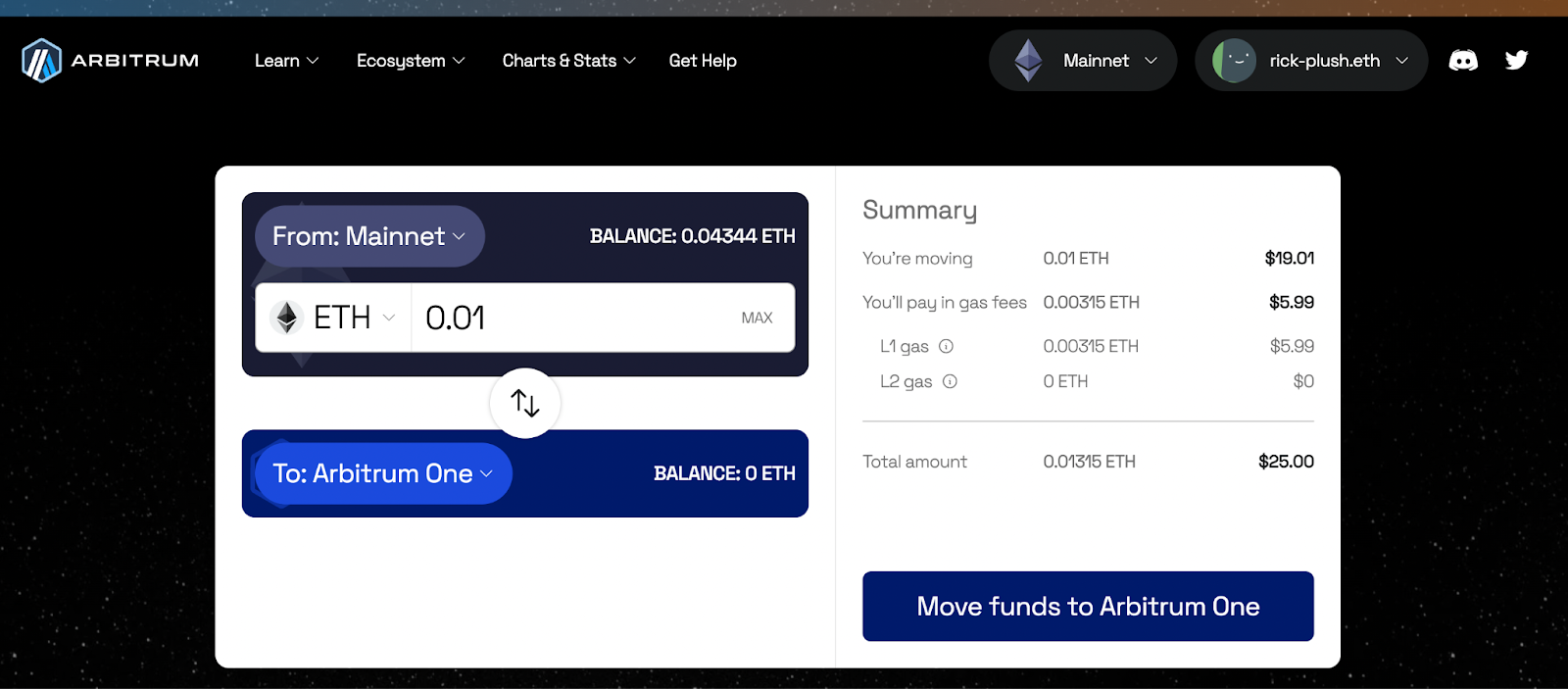
Then you should visit bridge.arbitrum.io and login with your wallet. You will see the following:
Choose the token you wish to bridge and specify the corresponding amount. A summary will be displayed, indicating the costs and the total amount you are about to transfer.
Once you are satisfied with the details, accept the transaction. This initiates the asset transfer process.
That’s it! You have successfully transferred your assets from Ethereum to Arbitrum One. The process for withdrawing assets follows the same steps, with the only difference being the selection of the “From” and “To” networks.
Final thoughts
In conclusion, Arbitrum Ecosystem has emerged as a promising Layer 2 (L2) solution within the Ethereum ecosystem. It offers significant improvements in transaction speed and cost-effectiveness, addressing the scalability challenges faced by the Ethereum network. Since its launch, Arbitrum has experienced impressive growth, attracting a diverse range of projects and establishing itself as one of the top players in the cryptocurrency world.
However, it is crucial to acknowledge that Arbitrum faces stiff competition from platforms like Polygon and Optimism. Polygon’s higher transaction speed and independent consensus mechanism, coupled with Optimism’s compatibility with Solidity, pose significant challenges to Arbitrum’s quest for dominance.
While Arbitrum has unique advantages, such as its AVM and seamless compatibility with Ethereum, it still has room for further development and refinement. It needs to address these challenges head-on and continue to innovate to secure its position as the go-to solution for scaling Ethereum effectively. It will be fascinating to see how it evolves and competes against its rivals in the race to become the number one project for scaling Ethereum.
We are always looking for Web3 talent !
Mighty Block is one of the partners of Forte, a platform to enable game publishers to easily integrate blockchain technologies into their games. We believe blockchain will enable new economic and creative opportunities for gamers around the world and have assembled a team of proven veterans from across the industry (Kabam, Unity, GarageGames, ngmoco, Twitch, Disney), as well as a $100M developer fund & $725M funding, to help make it happen. That’s where you come into play.
Feel free to browse all our current open job opportunities in the following link 👇
CCP Games has raised $40 million in funding to make a new triple-A blockchain game set in the Eve universe.
The new game is a big project and that’s why Reykjavík, Iceland-based CCP Games went beyond its owner Pearl Abyss to look for external funding. Andreessen Horowitz (A16z) led the round, with participation from Makers Fund, Bitkraft, Kingsway Capital, Nexon, Hashed and additional participants.
This financing will allow CCP Games to build upon the discoveries of its research and development team to enable the full-scale development of a new triple-A title utilizing blockchain technology, said CCP Games CEO, Hilmar Veigar Pétursson, in an interview with GamesBeat.
With key game systems developed on-chain, this new project will also leverage smart-contract blockchain technology, focusing on persistence, composability and truly open third-party development to create a new relationship between virtual worlds and players.
“Since its inception, CCP Games’ vision has been to create virtual worlds more meaningful than real life. Now, with advancements made within blockchain, we can forge a new universe deeply imbued with our expertise in player agency and autonomy, empowering players to engage in new ways,” said Pétursson. “This financing has marked an exciting frontier in our studio history as we begin our third decade of virtual world operations. We are humbled by the confidence from our partners in the development of this new title.”
Eve Online launched in May 2003. In September 2018, Black Desert creator Pearl Abyss of South Korea bought CCP Games for $425 million. It was a huge sum for a company running a game that has been around for almost 20 years and is still a big success. But this new idea called for outside investment.
Innovative Approach to Game Development
“CCP Games is a pioneer in virtual worlds and digital economies with 25 years of experience creating living sandboxes with unparalleled depth,” said a16z General Partner, Jonathan Lai, in a statement. “They’re a veteran team and we believe in their ambitious vision to deliver incredible player experiences at the intersection of best-in-class game design and blockchain technology.”
“The depth and nuances of EVE have become a frequent point of reference in blockchain gaming and we are therefore thrilled to support the team’s impressive vision of expanding the EVE Universe utilizing this technology,” said Makers Fund principal Alli Óttarsson, in a statement. “As a former employee, it’s a great personal joy to be reunited with CCP and to witness their continued passion for creating truly meaningful virtual worlds.”
“We’ve long marveled at stories of interstellar war, spaceships forever lost, and the constant challenges of staying ahead of emergent, sovereign play patterns,” said Bitkraft Ventures partner Carlos Pereira, in a statement. “Hilmar and the team’s experience is unmatched, and we’re excited to see how they use blockchain to let players dream further.”
Alongside independent financing, this new title’s production is separate from current and previously disclosed projects, including Eve Online, which is now in its landmark 20th year.
We are always looking for Web3 talent !
Mighty Block is one of the partners of Forte, a platform to enable game publishers to easily integrate blockchain technologies into their games. We believe blockchain will enable new economic and creative opportunities for gamers around the world and have assembled a team of proven veterans from across the industry (Kabam, Unity, GarageGames, ngmoco, Twitch, Disney), as well as a $100M developer fund & $725M funding, to help make it happen. That’s where you come into play.
Feel free to browse all our current open job opportunities in the following link 👇
Layer 2 Sets March 27 Launch Date for Ethereum Scaling Offering
Polygon, the Layer 2 blockchain, plans to deliver an Ethereum-compatible rollup powered by zero-knowledge proofs on March 27, the development team said on Tuesday.
The offering, which is called a zkEVM, is expected to offer enhanced privacy features and validate transactions faster than other Ethereum scaling solutions. Unlike other L2s powered by zero-knowledge proofs, developers will easily be able to deploy code written for Ethereum on Polygon’s offering.
‘Intense and Inspiring’
“After more than a year of intense and inspiring research, development, and testing, we are incredibly proud to launch the first-ever zkEVM mainnet,” Mihailo Bjelic, Polygon’s co-founder, said onTwitter.
The DeFi community is counting on rollups to scale Ethereum, which, despite its ubiquity, has proven ill equipped to handle the workload for decentralized finance. Rollups work by bundling together transactions on a Layer 2 network before submitting the bundle to Ethereum’s mainnet for processing. In other words, this innovation may be crucial in enabling Ethereum to fulfill its promise.
Arbitrum and Optimism, the top Layer 2 networks by total value locked, both use optimistic rollups. Optimistic rollups offer easy compatibility with the Ethereum Virtual Machine (EVM), Ethereum’s core smart contract engine — meaning developers can easily port their from Ethereum’s mainnet to Layer 2.
Rollups powered by zero-knowledge proofs have long been touted as the holy grail for Ethereum scaling due to their improved performance and faster settlement compared to optimistic rollups.
Next Bull Cycle
“[ZkEVMs] will definitely help scale Ethereum to support more transactions in the future and will be a sorely needed addition to support the next bull cycle,” Bobby Ong, co-founder of CoinGecko, told The Defiant.
Ong added that the teams that are earliest to secure zkEVM market share will enjoy a significant first-mover advantage over their competitors.
However, existing solutions are not compatible with the EVM, meaning developers historically have needed to build code from scratch to deploy it on ZK-rollups.
But on July 20, 2022, Scroll, Polygon, and Matter Labs all announced they were developing rollups secured by zero-knowledge proofs, or zkEVMs. Consensys, the blockchain software company chaired by Ethereum co-founder, Joseph Lubin, also revealed it was working on a zkEVM in November.
While Polygon is the first team to publicly reveal a date for the launch of its zkEVM, Scroll has outpaced its rivals in terms of testnet adoption.
Driven by Speculation
More than 900,000 unique wallets have interacted with the testnet for Scroll’s zkEVM, compared to 544,309 for Matter Labs’ zkSync 2.0 testnet, 85,166 for Polygon, and nearly 20,000 for Consensys, according to Messari.
However, the high levels of testnet activity for Scroll and zkSync 2.0 may be driven by speculation that the projects may airdrop native tokens to early adopters in the future.
Zero-knowledge proofs are a privacy-preserving encryption method that was pioneered in the 1980s but struggled to find product-market-fit until Zcoin and Zcash leveraged the technology for privacy coins in 2016.
We are always looking for Web3 talent !
Mighty Block is one of the partners of Forte, a platform to enable game publishers to easily integrate blockchain technologies into their games. We believe blockchain will enable new economic and creative opportunities for gamers around the world and have assembled a team of proven veterans from across the industry (Kabam, Unity, GarageGames, ngmoco, Twitch, Disney), as well as a $100M developer fund & $725M funding, to help make it happen. That’s where you come into play.
Feel free to browse all our current open job opportunities in the following link 👇
If you’re interested in blockchain technology, gaming and then our podcast is for you!
Listen to experts in the field discuss the latest developments and future potential of using blockchain, the latest news related with blockchain technology and the gaming industry.
Tune in to stay informed and ahead of the curve in the world of blockchain and gaming:
Episode 9: Educación y Seguridad en Web3
In this episode, we chat with Pablo Sabbatella about Education and Security. Two concepts that go hand in hand and are key when onboarding the next billion users of Web3.
Episode 8: Puede Blockchain desplazar a las bases de datos relacionales?
We chat with Javier Villegas, an expert in relational databases, about the differences between various types of storage. Additionally, we discussed the technology that best applies to each specific case.
Episode 7: Descentralizando la identidad con Web3
If you’re interested in learning more about decentralized identity in Web3, then you won’t want to miss our latest podcast episode. Our expert guests, Milton Berman, share their experiences and insights into the potential of decentralized identity.
In this episode, you’ll learn about the benefits of decentralized identity, including increased privacy and security. Our guests also discuss the practical applications of this technology.
Whether you’re a developer, entrepreneur, or simply curious about Web3, you’ll find something valuable in this episode. So be sure to tune in and discover the potential of decentralized identity for yourself!
Episode 6: Emprender en Web3
Check out our latest podcast episode featuring the CEO and founder of Mighty Block, Franco Breciano. In this episode, we dive deep into the world of web3 and the future of the business ventures in this exciting new space.
Episode 5: De space invaders hacia Crypto traders
Recommended for gamers and those who want to learn more about this world! How have video games evolved to web3? What is coming in the future? In this episode, Sebastian Perez (Tech Lead at Mighty Block) and Uri Chami (Solidity Developer at Mighty Block) discuss these topics.
Episode 4: El camino de Web2 a Web3
In this episode we talk with our guest Milton Berman, WakeUp Labs founder and CEO, about the process through web2 to web3
Episode 4: Resumen del mundo Crypto 2022
2022 was a year of unprecedented events for the cryptocurrency ecosystem. With Diego Gurpegui Improve-in Co-founder and CTO we took a look back at the most important events of the year.
Bitcoin and Ethereum are the world’s most popular blockchain networks. We discuss with Diego Gurpegui Improve-in Co-founder and CTO about the differences and benefits of each one.
Episode 1
In our first episode we talkwith Emiliano Canedo (web3 researcher and digital artist) about Ethereum: The merge, the history and the future.
We are always looking for Web3 talent !
Mighty Block is one of the partners of Forte, a platform to enable game publishers to easily integrate blockchain technologies into their games. We believe blockchain will enable new economic and creative opportunities for gamers around the world and have assembled a team of proven veterans from across the industry (Kabam, Unity, GarageGames, ngmoco, Twitch, Disney), as well as a $100M developer fund & $725M funding, to help make it happen. That’s where you come into play.
Feel free to browse all our current open job opportunities in the following link 👇
The city will allow taxpayers to make crypto payments through third-party service providers.
The city of Rio de Janeiro is seeking crypto firms to operate its tax property seasoning in 2023, according to a decree published on Oct. 11, allowing taxpayers to use crypto alongside fiat currency to pay tributes. The move makes Rio the first Brazilian city to accept digital assets as payment for taxes.
It is expected that taxpayers will be able to pay with more than one crypto asset and that other types of taxes will be enabled in the future, the city stated. The decree also states that companies willing to provide the services must be registered with the city and comply with the Brazilian Securities and Exchange Commission (SEC) requirements.
The hired companies will provide cryptocurrency payment services and convert crypto into fiat currency. Funds will be transferred to the city in local fiat currency without any additional cost to taxpayers. Mayor Eduardo Paes said in a statement:
“Rio de Janeiro is a global city. Therefore, we are following technology and economic advances in the universe of digital financial assets. We have a look to the future and we want to become the country’s capital of innovation and technology. Our city is the first in Brazil to offer the taxpayer this type of crypto payments.”
Similar actions have been taken around the world. In September, the United States state of Colorado started accepting crypto payments for any taxes owed. The legislatures of Arizona, Wyoming and Utah have all introduced bills to accept tax payments in the form of digital currencies to varying degrees.
Rio de Janeiro’s initiative is another example of the efforts being made in the country to broaden adoption. Recently, the number of companies holding cryptocurrency in Brazil has reached record highs as of August, as the local taxation authority, Receita Federal do Brasil, recorded 12,053 unique organizations declaring crypto on their balance sheets in August, up 6.1% over July.
We are always looking for Web3 talent !
Mighty Block is one of the partners of Forte, a platform to enable game publishers to easily integrate blockchain technologies into their games. We believe blockchain will enable new economic and creative opportunities for gamers around the world and have assembled a team of proven veterans from across the industry (Kabam, Unity, GarageGames, ngmoco, Twitch, Disney), as well as a $100M developer fund & $725M funding, to help make it happen. That’s where you come into play.
Feel free to browse all our current open job opportunities in the following link 👇
Since the cryptocurrency market crash in 2021, investors have evidently been longing for some positivity in the markets. This was evident through the numerous social media posts or tweets throughout the recent months.
However, the industry took a turn contrary to these wishes and has been bombarding the masses with negative developments within the space for a while now. This has started to change only recently, with a frequent wave of price hikes being seen in the markets every now and then. But, the development that the entire industry has been excited about for a long time now is the Ethereum Merge.
What is the Ethereum Merge?
Considered to be one of the most awaited cryptocurrency events in 2022, Ethereum had been planning the Merge for a while now. The foundation had announced tentative dates for the actual merge on 24th August this year.
This announcement itself was enough to fuel the markets to pump almost every altcoin that has something to do with the leading cryptocurrency.
The Ethereum Merge is the team’s solution to create a better version of the project, by minimizing several obstacles it had been facing before. Ethereum was highly criticized for a long time for the amount of energy it uses and the carbon footprint left behind by it. Infact, its energy consumption for one transaction amounted to almost 6.76 days worth of electricity consumed by an average U.S household.
This drawback was set to be removed eventually and the event had been planned way back. The solution Ethereum came up with was to change its current PoW(Proof of Work) mechanism to a better, eco-friendlier PoS(Proof of Stake) setting. The foundation claims that this move will reduce the energy requirement of ethereum transactions by around 99.95%.
Bellatrix is now live
The Merge is set to happen in two phases- Bellatrix(now live) and Paris. As part of the network that hosts decentralized apps, Bellatrix is an update to the Ethereum Virtual Machine. The Ethereum Foundation states that the update will make the network more secure, perform better, and scale better. Ethereum 2.0 is being implemented as a result of the protocol.
Therefore, as decided, the Bellatrix upgrade has been activated on Beacon Chain epoch 144896. This upgrade itself was enough to put investors in a state of excitement, with its Twitter community showing massive support through several posts and tweets.
“Post the merge, node operators will be stuck on an incompatible chain following old rules and will be unable to send Ether or operate on the post-Merge Ethereum network”, the foundation mentioned.
It is not necessary for ETH holders to do anything with their funds or wallet after the Merge, as the genesis will remain intact and unchanged. Holders will be able to access their funds with ease after the upgrade too. However, the Ethereum Foundation has explicitly warned that investors must take extra care to not fall prey to any fraud or scams in the market.
Since there has been a surge in scammers looking to dupe users in the name of providing “ETH V2” tokens or similar aliases, Ethereum had issued warnings on the website long ago.
Since the Bellatrix upgrade has been a huge success all eyes are now set to be on, the Parsi upgrade which is anticipated to be sometime around the 14th of September. The process is expected to roughly take up to 13 minutes and will be initiated once the terminal total difficulty is at 5870000000000000000000 and the requirement of the first PoS block creation is met.
Several major influencers in the space; even the CEO of Ethereum Network Vitalik Buterin have been active in keeping the masses updated throughout the event. This is because the upgrade is a determining development for Ethereum and the variety of applications it supports.
The effect on ETH and the whole industry
The price of Ethereum, despite such major announcements, is yet to make a major move. It is likely that the price may explode in the future rather than now since the update will have long-term benefits. However, it did cause a price spike in many ETH-based altcoins.
A majority of these tokens were either projects that were built on Ethereum or simply the ones which in some way supported the network. At the time of writing, ETH is trading at around $1540 with a market cap of more than $188 billion.
We are always looking for Web3 talent !
Mighty Block is one of the partners of Forte, a platform to enable game publishers to easily integrate blockchain technologies into their games. We believe blockchain will enable new economic and creative opportunities for gamers around the world and have assembled a team of proven veterans from across the industry (Kabam, Unity, GarageGames, ngmoco, Twitch, Disney), as well as a $100M developer fund & $725M funding, to help make it happen. That’s where you come into play.
Feel free to browse all our current open job opportunities in the following link 👇
Crypto gaming DAO Matchbox has raised $7.5 million to build core products and promote development on StarkNet.
MatchboxDAO, a Starkware-based on-chain gaming ecosystem, has raised $7.5 million in its first funding round to continue improving crypto games built on the Ethereum scaler StarkNet.
The funding round was backed by prominent blockchain investors, including Starkware, Geometry Research, ReadyPlayerDAO, Neon DAO, Road Capital, Formless Gamma, and Bonfire Union.
“Matchbox is helping new gaming apps to set foot in expanding the gaming realm of the StarkNet ecosystem,” said Uri Kolodny, StarkWare’s co-founder and CEO. “Their support and mentorship for game builders are an important contribution for StarkNet.”
StarkNet is a scaling solution for Ethereum built by Starware and uses rollups. Instead of processing transactions on the blockchain’s mainnet, rollups move activity off-chain to ease congestion.
“Matchbox is on the route to building the next wave of infrastructure for the next-gen of games,” said Yonatan Ben-Shimon, Matchbox Foundation’s CEO. “Composable games and Dapps that empower devs and creators as well as hundreds of millions of users.”
The freshly-raised funds will be used to develop the two core products of MatchboxDAO, namely Matchbox Spark and Matchbox Studios.
Matchbox Spark incubates gaming products on StarkNet, while Matchbox Studios is a set of development tools to accelerate game development on Starknet.
“Matchbox Spark is already happening for a month but we’ve come up with a new structure as we get more and more traction,” Ben-Shimon told Decrypt. “MatchBox Studio will be announced soon.”
Bringing crypto games to Starknet
In order to tokenize an in-game asset on the blockchain, gamers must pay gas fees.
Unfortunately, due to Ethereum’s often sky-high gas fees and slow transactions, executing these kinds of transactions is not ideal for scalable gaming applications.
Layer-2 solutions like Starkware offer cheap and rapid transactions alongside improved privacy, making it an ideal candidate for game development.
“The privacy of ZKP is definitely why we wanted to be on StarkNet,” Ben-Shimon told Decrypt. “Having the possibility to hide information but to prove its existence on-chain is one of the major innovations for on-chain games (for a strategic game for example).”
We are always looking for Web3 talent !
Mighty Block is one of the partners of Forte, a platform to enable game publishers to easily integrate blockchain technologies into their games. We believe blockchain will enable new economic and creative opportunities for gamers around the world and have assembled a team of proven veterans from across the industry (Kabam, Unity, GarageGames, ngmoco, Twitch, Disney), as well as a $100M developer fund & $725M funding, to help make it happen. That’s where you come into play.
Feel free to browse all our current open job opportunities in the following link 👇
One of the first things we learn in Solidity/Ethereum is that contracts are immutable. If you upload a contract on the blockchain, you can’t change its source code and therefore you can’t change its logic.
We must be extremely careful with the code we use: if we make one simple mistake it could be extremely expensive. That’s why we consider alternatives as a way to avoid this limitation. Let’s see how we can use an upgradeable contracts.
Contracts Old School
The simplest thing we can do is upload a new version of the contract (and thus a new deploy and a new address). But this has its issues, for example let’s think about what it was like to have a shop a few years ago (before the internet). If we wanted to move to another address, we had no way of notifying all our clients and potential future clients of this change. The same thing happens in smart contracts, all users must know that the address has changed, but not having a user registry makes it very difficult.
Ways to create a upgradeable contracts
There are currently 4 ways to create an upgradeable contracts.
Using an interface / proxy
Taking advantage of inheritance and polymorphism, an interface with the contract structure can be exposed. So now we have two contracts: one with the contract definition (and external calls) and the other with the function’s implementation. The user interacts with the contract through the interface and if an update is required, the address of the contract is simply changed for the new version in a simple variable inside the contract.
It is not possible to modify the contract’s structure since we MUST respect its interface, but its main disadvantage is that the stored values will remain in the contract that has the logic, and if we want to update it with that of another contract, we will lose the storage state.
What is done to solve the storage issue is to have a “proxy” contract that has the same structure as the one with the logic, and it is accessed through the delegatecall instruction. It is SUPER IMPORTANT to keep the same variable structure in the contracts since we will be sharing the storage, and if both do not have the same variable structure, a collision could occur. A possible solution for this is that they both inherit from a base contract that sets the same variable-structure for all of the contract versions.
It seems to be a better alternative but in terms of gas it is expensive: we are always adding variables that we will most likely never use in every logic contract we implement. This can be improved if a third-party storage contract is used, for this, we can use solutions such as OpenZeppelin or combine it with an unstructured storage.
OpenZeppelin Transparent Proxy
If you are a user of the OpenZeppelin contracts you have noticed this plugin for sure. Inside, it uses a mechanism known as Transparent Proxy, which uses unstructured storage to avoid collisions (as long as we add the variables at the end and never at the beginning). This proxy is already integrated as a plugin and is compatible with Hardhat and Truffle.
This is one of the most popular and most complex, since we have an intermediary contract, but instead of aiming for a single final contract, each function will be implemented in a different smart contract. In addition, each “Facet” contract (as they are called) will have a fixed memory space to avoid collisions. A major advantage is, a whole contract deployment is not required, just a contract with one function implementation. That’s cheaper than deploying a complete-structure contract with all of the functions and also as there is just one function per contract, the size limit is very hard to reach. It is undoubtedly the favoured solution for the complex scenarios that are created today and there is even an EIP that refers to it.
At ETH Latam event, Alejandro Santander (known as The Ethernaut) presented a solution called Router Proxies. It is quite similar to the Diamond Pattern, but simpler. I recommend watching this talk!
What? Well, we are not actually modifying the contract,but if we had the ability to remove the contract from storage, we could force a deployment to that same address, then replace one contract with another.And this is how this technique works. Through the selfdestruct() statement, it is possible to remove a contract from the blockchain storage, and using the create2 operation, a new version of the contract is deployed to THE SAME ADDRESS.
In centralized software, not only is this not a bad thing, it is a necessary thing. What happens in decentralized projects? Who should update the code? Is a DAO reliable enough? On the one hand, an immutable contract seems more reliable than an upgradeable contracts but it also makes it more vulnerable to attacks. In my opinion, it is good to consider all these alternatives and use them if the project requires a sophisticated architecture. Making a contract upgradeable makes its code much harder to understand and trace, but improves its resistance to attacks. If the strength of a project is its simplicity, I would not work on making the contract updatable, but I would do so in complex projects with multiple contracts.
We are always looking for Web3 talent !
Mighty Block is one of the partners of Forte, a platform to enable game publishers to easily integrate blockchain technologies into their games. We believe blockchain will enable new economic and creative opportunities for gamers around the world and have assembled a team of proven veterans from across the industry (Kabam, Unity, GarageGames, ngmoco, Twitch, Disney), as well as a $100M developer fund & $725M funding, to help make it happen. That’s where you come into play.
Feel free to browse all our current open job opportunities in the following link 👇