


In today’s digital age, our lives are intertwined with online platforms, posing questions about ownership and control of digital identities.
In today’s digital age, our lives are intertwined with online platforms, posing questions about ownership and control of digital identities.

2023 is behind us, and as we step into the new year, we’re faced with a fresh set of opportunities. The past year, dominated by a bear market, was a real test for the web3 ecosystem. We witnessed many projects struggling to stay afloat, while others not only survived but thrived by adding real value to the ecosystem. As we look ahead to 2024, it’s clear that the experiences of the past year have set the stage for new trends that are about to unfold. In this article, we’ll explore five key web3 trends that every product manager in the ecosystem should be aware of.

Identity – Dall·e
2024 is poised to be a crucial year for digital identity. For product managers working on services or applications that require authentication, focusing on decentralized identity management will be essential. This approach puts users in control of their data, allowing them to share only what is necessary for an application’s functionality. We can also expect a rise in the use of verifiable credentials, with Zero Knowledge proofs (ZK proofs) enabling the sharing of proof without revealing the underlying data.
The benefits of decentralized identities and verifiable credentials are significant for both end-users and organizations.
This web3 trend extends beyond the domain of web3 developers and organizations. Public sector advancements are also evident:
In Switzerland, Partisia Blockchain and the University of Applied Sciences and Arts Western Switzerland (HES-SO Valais-Wallis) are collaborating on a decentralized electronic identity system, focusing on privacy and individual data control. Meanwhile, China is advancing its blockchain ambitions with the RealDID initiative, aiming to create a national-level real-name decentralized identity system. These developments reflect a global move towards more secure and user-controlled digital identities
If you are an Spanish speaker, i strongly recommend you this podcast from our Mighty Block series: “Descentralizando la identidad con web3”

Regulations – Dall·e
Regulatory aspects, especially concerning the SEC and ETFs, are becoming increasingly important in the web3 space. As the industry matures, adherence to regulatory norms and governance standards is crucial for ensuring sustainable growth and user trust. Many countries already have some regulations or guidelines for Crypto space.
Recent regulatory developments underscore this trends:
For product managers in the web3 ecosystem, staying informed and compliant with these evolving policies and regulations is a must. It’s not just about creating secure experiences; it’s also about safeguarding our end-users from potential risks and ensuring our services align with this new regulatory landscape.

Bored Ape Reload for 2024 – Dall·e
The NFT landscape in 2023 saw a slowdown, with collections like Bored Ape Yacht Club and Azuki Elementals experiencing significant drops in value. Marketplaces such as OpenSea and Blur responded to this bear market by reducing to try to maintain the interest on people and capture market share
In 2024 the expectation looks more promising, expanding NFT scope beyond just art. A key area of growth is in gaming, which, despite being in the early stages of web3 development, is increasingly integrating NFTs. These digital tokens are an essential part of gaming, providing players ownership of in-game assets, which can then be collected or traded in secondary markets.
As for projections, Blockworks suggests significant growth in the web3 gaming sector,
Even if this is not as evolved as gaming, other usage is traceability of physical assets. The transparent blockchain ledger effectively tracks the ownership history of an NFT, bolstering authenticity and provenance.
Consequently, NFTs stand poised to revolutionize the realm of real-world asset ownership and management. In the future, utilizing NFTs could span a wide spectrum of assets, such as art, collectibles, real estate, and even securities.

Onboarding from web2 to web3 – Dall·e
To truly mainstream web3 and welcome the next billion users, it’s crucial we shift our focus towards a wider audience. Sure, in the web3 space, we’re all about privacy and security – the whole ‘not your keys, not your assets’ mindset. But let’s be real: this appeals more to the early birds and tech enthusiasts who are willing to dive deep.
To grow our ecosystem and make it robust, our game plan should include attracting people, guiding them step-by-step, and gradually unveiling the myriad possibilities of web3.
This year is going to be all about seamless onboarding. As product managers, we need to analyze the onboarding process. How can we borrow and adapt what worked in web2 to make web3’s decentralization more gradual and user-friendly? Our goal here is to ensure our users feel at ease and build confidence in navigating through this new tech landscape.
The Blockchain meets the AI – Dall·e
2023 was, without doubt, the year of AI. When this phenomenon appeared in our lives, we started to think about how to collaborate with the decentralized ecosystem. Is blockchain and AI something that naturally is going to work together? According to Vitalik, in the Podcast La Ultima Frontera, “…A lot of people want to be a connection and it’s sometimes hard to find a really big and deep one. There are definitely some smaller ones, for example ZKML (Zero Knowledge Machine Learning)”
Does this mean that as Product Manager we don’t need to worry about this? Well, actually the IA is an incredible tool to help us to improve our products, accelerating the research, helping to brainstorm, or as a simple assistant in our daily operative tasks. So even if there is not an immediate correlation between web3 and AI, is definitely one between what we can achieve using this tool to enhance the ecosystem with our products.
In summary, 2024 for web3 Product Managers is about embracing innovation responsibly, focusing on user empowerment, navigating the evolving regulatory environment, broadening the utility of NFTs, simplifying onboarding, and exploring the synergies between AI and blockchain; to create a safer, more inclusive, and vibrant web3 ecosystem.

Seed phrase and private key are two terms that are tightly related but are different things. When setting up a new crypto wallet such as Metamask, Ledger or Trezor, among others, a list of 12 or 24 common words is given to the user to back up. That list is the so-called seed phrase, an “easy to remember, easy to backup” word list.
A private key is a large binary string used by a crypto wallet for signing the transactions that later will be sent to the chain.
In this article we are going to take a journey from the generation of the seed phrase to the multiple wallet address generation, making a special stop at the private key creation and paying attention to the technical details of this process.
BIP stands for Bitcoin Improvement Proposal. They are documents that describe a proposal for improving the Bitcoin blockchain ecosystem. BIP39 is called “Mnemonic code for generating deterministic keys” and describes the process of generating the mnemonic code. Here’s how it is done:

The words are taken from a word list that is available in several languages. The length of the list is always 2048 (2048 = 2¹¹, the number of bits used for grouping ENT + CS).
The quantity of words produced depends on the amount of entropy bits (ENT – the randomness factor of the initial seed). Typically the lengths used are 128 bits, leading to 12 words, and 256 bits, resulting in 24 words.
Once the mnemonic seed phrase is obtained, numerous private keys can be generated from it. That is why wallets such as Metamask and Trezor are able to generate any number of accounts needed with only one seed phrase.
To generate the private keys from the seed phrase, the initial step involves computing a binary seed derived from the mnemonic. This computation uses the key stretching algorithm PBKDF2 with HMAC-SHA512, where the seed phrase is concatenated with the string “mnemonic” and a password utilized as a salt. In instances where no password is utilized, only the term “mnemonic” is appended.

Employing PBKDF2 increases the time and computational power needed for brute-force attacks, rendering it highly impractical to utilize this approach for cracking a seed phrase.
It is worth mentioning that this process and the seed phrase generation are completely separated processes. This process can be used with a mnemonic seed generated from a totally different process.
Now it is time to use the binary seed to generate private keys (and from those, public keys and wallet addresses). The following process describes what it is known as a HD Wallet (Hierarchical Deterministic Wallet). First we need to create a Master Private Key, a Master Public Key and a Master Chain Code from the Binary seed:

From this derivation we will produce all the accounts we need in a deterministic way. To create new accounts, we require:

In the diagram above we used the Master Private Key, but as said earlier we can also use the Master Public Key. The difference between using one or the order is generating a Hardened Key or a Normal Key, but that is out of the scope of this article.
We can create a virtually limitless quantity of private keys with this method either by changing the index or using a Child Key as a Master Key and repeat the process. This way we can have a tree of private keys.
We saw how a seed phrase is generated, used to generate a binary seed that then is used to generate a Master Private Key. This Master Private Key allows us to generate multiple Child Private Keys.
Public Keys and Wallet addresses are derived from Child Private Keys. It is a chain of derivation:

Does this mean that I always need a seed phrase to generate private keys? No! In fact, at the beginning of the blockchain era, all private keys were created individually.
Is it worth trying to guess a seed phrase? Imagine that your seed phrase is composed of only one word of the word list. This means that the attacker has to try only 2048 combinations to derive your private key and steal all your assets. Suppose that deriving a private key with a specific combination takes 1 millisecond, then, it would take around 2 seconds to test all the possibilities!
Imagine now that your seed phrase is composed of two words of the word list. This means that the attacker has to try 2048 x 2048 = 2048² = 4194304 combinations to derive your private key. Assuming the 1-millisecond scenario, it would take the attacker around 1 hour and 10 minutes to test all the possibilities. That is a lot more!
Let’s repeat the process but now with 12 words. This means the attacker has to try 2048¹² = 5444517870735015415413993718908291383296 combinations. It would take around 2048¹²÷1000÷60÷60÷24÷365 ≈ 172644529132896227023528466479 years.
We saw the main difference between seed phrase vs private key, how it helps to keep your assets safe (by saving a phrase instead of a very long easy to forget number).
Are we at the end of the road? It doesn’t seem to be the case, even though this is a huge improvement on how wallets are created, managed and recovered it is still not enough to enable massive adoption of the crypto ecosystem. There are currently a lot of efforts to make the crypto space more user friendly. A proof of that is Ethereum’s ERC-4337, known as “account abstraction” that will, among other things, allow the user to use standard methods of authentication such as fingerprint instead of having to store a mnemonic phrase.
The crypto space traveled a long distance to be where it is today, but there’s still a lot ahead that needs to be explored, new methods to develop and new things to be discovered. In my opinion, this is just the beginning of this amazing trip. Even though mnemonic phrases are the way-to-go today, it is worth paying attention to the new solutions that arise from the community. One or many of those new ideas will help to on-board the next generation of users and allow the mass adoption of this amazing technology.
Mighty Block is one of the partners of Forte, a platform to enable game publishers to easily integrate blockchain technologies into their games. We believe blockchain will enable new economic and creative opportunities for gamers around the world and have assembled a team of proven veterans from across the industry (Kabam, Unity, GarageGames, ngmoco, Twitch, Disney), as well as a $100M developer fund & $725M funding, to help make it happen. That’s where you come into play.
Feel free to browse all our current open job opportunities in the following link 👇

In this article, we aim to share our approach to personal development and the cultivation of a robust start up culture, which has transformed us into a high-performance team deeply rooted in our core values.
With the management team, we had a vision: a high-performing team with strong bonds that would enable us to uphold open and honest communication. It may sound like a lot because it wasn’t a feature we could simply develop and consider “done”; it required us to embrace learning and experience some discomfort.
We selected the concept coined by Carol Dweck, the ‘Growth Mindset,’ as the central theme for the year.
In essence, the concept introduced by Carol Dweck can be summarized as follows: Individuals who believe in the potential for their talents to develop through hard work, effective strategies, and input from others possess a growth mindset. They tend to achieve more than those with a fixed mindset who believe their talents are innate gifts. This is because those with a growth mindset worry less about appearing intelligent and invest more energy into the process of learning.
When entire companies embrace a growth mindset, their employees report feeling significantly more empowered and committed. Additionally, they receive increased organizational support for collaboration and innovation. In contrast, individuals in companies primarily rooted in a fixed mindset tend to report more instances of cheating and deception among employees, presumably as an attempt to gain an advantage in the talent competition.

We chose this concept to serve as our guiding principle whenever our team faced an obstacle. The first thing we did was to share it with the team and reinforce it in every conversation opportunity. When designing the training for team leads, we knew it was crucial to rely on this concept to implement the changes and improvements we envisioned for our ‘Clarity Break’ training.
But how did we first come to embrace this concept? We have a Friday tradition that has been with us since the first day of Mighty Block: Crypto Research. Originally, it was a forum where we discussed various topics related to crypto that had been researched. This was crucial in the early days of the company when the crypto industry was rapidly expanding, and our team was relatively new to blockchain. It was essential to stay updated on all the latest developments.
However, recently, it became tedious to find a NEW topic for research related with crypto. We would prepare it without enthusiasm, procrastinate, and so on.

To address this issue, we began to contemplate the two models, framed by the ‘victim vs. protagonist’ dichotomy introduced by Freddy Coffman. What does a victim do when they don’t like Crypto Research? They complain, get frustrated, and kick it – were some of the responses we received.
On the other hand, as protagonists, we seized an opportunity during a workshop we held in Cordoba. Together, we designed a new format, made commitments, and implemented the change. We would no longer confine ourselves to a single topic (crypto), but instead, we would include subjects that positively impact our daily lives. Additionally, we could invite guests and introduce special editions featuring panel discussions. Change the name help us to not limited ourselves and give to “the mighty show” a new beginning

In order to learn from each other, take more risks, and grow as a team, we needed to ensure that we had the skills to provide feedback in an open and honest manner. That’s why it was essential to dedicate time during the workshop we held in Buenos Aires to discuss those ‘monsters’ that make us hesitant when it comes to giving feedback.

Fears of having to take on extra tasks, fear of hurting someone else’s feelings, fear of being wrong in my assessment, among others – identifying these fears helped us. We created actions in collaboration with the leads to ‘combat’ them and encourage each other to embrace the open and honest mindset. Later, during a virtual discussion, we explored the best tips for effective communication when giving feedback. We reviewed do’s and don’ts to enhance our feedback process.
Mistakes are a fundamental source of learning in a start up culture, and we’ve been discussing what happens to us when we make mistakes, the emotions and feelings we experience, and how we can make the most out of our errors. In a special session of our Friday “Mighty Block Show”, we learned that the key to evolving from the traditional concept of failure is not to view success and failure as a binary but to incorporate them into the learning process.
We shared our experiences with error and took away some key insights: When we’re trying to resolve an error, it’s beneficial to take a moment to clear our minds, seek help, and breathe. When someone shares a problem or mistake they’ve encountered, it’s essential to assist and make them feel comfortable and supported. We emphasized not getting caught up in the mistakes – they don’t define us.

At our start up culture, we have a unique tradition. Every quarter, we come together as a team for an entire week. During our recent gathering, we revisited the invaluable lessons we’ve learned throughout the year.
With the theme of ” Strong Growth” in mind, we approached our learning experience in a playful way. We incorporated various games to enhance our understanding of these lessons. We recognized that mistakes are an integral part of the learning process; they are the stepping stones to success. We also acknowledged the value of maintaining a player’s attitude – being open to new challenges and eager to explore uncharted territories. We also learned that frustration and expectations often go hand in hand. By acknowledging this fact, we can navigate our professional journeys with greater resilience and a clear perspective.
One of the most exciting outcomes of our learning journey was the construction of a Jenga tower. This tower, where each block represented our learnings and experiences, serves as a symbol of our team’s commitment to growth and our evolving organizational start up culture. It visually represents how we stack our achievements, learn from our failures, and build a stronger and more resilient team.

Incorporating playful learning into our professional development has not only made our quarterly gatherings more enjoyable but has also proven to be an effective way to drive our team’s personal and collective growth. We look forward to the upcoming quarters with renewed enthusiasm, ready to embrace the challenges and successes!
Check out this video with our experience in the last workshop.

In this article we want to share with you an introductory guide about ERC20 tokens
A thing serving as a visible or tangible representation of a fact, quality, feeling, etc. It also has a value that is associated with its context.
Non fungible: Non-fungible means that something is unique and can’t be replaced. By contrast, physical money and cryptocurrencies are fungible, which means that they can be exchanged for another object with the same attributes.
Fungible: Replaceable by another identical item; mutual interchangeable.
Standard representation for fungible tokens.
Identified by Name and Symbol, allows to transfer from your account balance and approve other accounts to spend in behalf of your account.

Implementation: Although what matters is the interface, it is advisable to use an implementation that is already tested and verified. I recommend the one from OpenZeppelin: https://github.com/OpenZeppelin/openzeppelin-contracts/blob/master/contracts/token/ERC20/ERC20.sol

Interoperability: Most decentralized applications support standards, this makes our token able to work in these scenarios.
No Vulnerability: Using tested and verified implementations means we avoid making mistakes in the implementation of tokens.
Easier: It makes it easy to integrate tokens into your contracts, so you only have to worry about calling functions.
Stable coins (DAI, USDT)
Fans Tokens (AFA Token, PSG Token)
Governance (Maker, Uniswap)
Play to earn (A)
ERC1155: Multitoken standard
ERC777: add hooks to the transfers.
ERC677: allows to customize the callback function for the transfer.
ERC223: improves the security of the token transactions.
A native currency has its own issuance and transfer rules tied to the network implementation. On the other hand, tokens allow the issuance and transfer rules to be customized, in addition to representing assets that are not necessarily related to finances, taking advantage of all the security and decentralization of the blockchain.
You can visit this video by @sebaleoperez with the ERC20 presentation in EthBogota 2022.

This article was written by Boro and Uri, Mighty Block blockchain developers, You will find in it the path to becoming a Smart Contract Developer!
Stepping into the digital realm’s dynamic frontier, where innovation intertwines with decentralization, is the path of a smart contract developer. In a world shifting from Web 2.0 to Web 3.0, our role has gained unprecedented prominence.
Imagine writing code that represents unalterable agreements and cutting out intermediaries – that’s the magic of smart contracts. This article is your gateway to understanding what it takes to become a master of this blockchain-powered craft. From unraveling the intricacies of different programming languages to illuminating the deployment process on diverse blockchain platforms, we’ll embark on a journey that unveils the profound evolution from lines of code to immutable digital contracts.
At its core, a smart contract is a decentralized digital agreement that runs on a blockchain. Imagine a traditional contract that outlines the terms and conditions of a transaction or agreement. And now envision this contract automated, enforced, and executed without needing intermediaries. This is where smart contracts shine.
Structurally, code composes a smart contract and defines the rules, logic, and conditions of an agreement. Think of it as executing a virtual ‘if-then’ statement: if certain pre-defined conditions meet, then the contract executes a specific set of actions. This structure ensures the transactions to be tamper-proof, transparent, and irreversible once executed on the blockchain.
In the evolution of the internet, we’ve moved from the static websites of Web 1.0 to the interactive platforms of Web 2.0. The transition to Web 2.0 brought us social media, online collaboration, and user-generated content, all centralized on platforms owned by big tech companies.
However, the model came with drawbacks. User data privacy concerns and the centralized control of information became apparent as platforms monetized user data and exercised content moderation power.
This sets the stage for Web 3.0, a decentralized paradigm shift. Web 3.0 leverages blockchain technology to distribute control, data ownership, and transactions across a network of participants. This means that users own more of their data and identities, and execute transactions in a transparent and secure manner without intermediaries.
As data breaches, content censorship, and privacy issues continue to plague the digital landscape, the move towards Web 3.0 gains momentum. Its emphasis on user empowerment, privacy, and open protocols is driving innovation. With the potential to redefine how we interact online, from social networking to financial transactions.
Let’s say we want to create an ERC20, the MightyBlockCoin that goes by the ticker MBC, our contract should keep track of MBC wallet balances, allow to transfer between wallets, amongst other functionalities. This is what the structure of such a contract would look like:
Venturing further into the realm of developing smart contracts, it’s crucial to grasp the landscape of blockchain ecosystems and programming languages that power them.
We can broadly categorize blockchain platforms into those that utilize the Ethereum Virtual Machine (EVM) and those that don’t. EVM-based blockchains, like Ethereum blockchain itself, offer a standardized execution environment for smart contracts, ensuring consistency across different nodes. On the other hand, non-EVM blockchains networks, such as Algorand and Solana, employ their own unique execution environments optimized for specific purposes.

When it comes to programming languages for a smart contract developer, Solidity stands tall as the primary choice for Ethereum-based contracts. It is a statically-typed language specifically with a design for writing smart contracts. That is the importance of Solidity smart contract development.
Vyper is another language for Ethereum network that focuses on security and simplicity, making it a preferred option for scenarios where code clarity is paramount. Beyond Ethereum, Rust has gained attention for its use in the Solana blockchain due to its efficiency and safety features.
But programming languages are just one piece of the puzzle. Testing and development environments play a crucial role in ensuring the reliability of a simple smart contracts. Tools like Hardhat, a JavaScript-based development environment, and Brownie, its Python counterpart, provide testing, deployment and debugging capabilities.
They enable developers to simulate blockchain environments locally, helping to catch errors and security vulnerabilities before deployment. These tools offer sophisticated testing frameworks and integration with popular testing libraries, enabling developers to write comprehensive test suites to ensure contract functionality and security.
Navigating the landscape for smart contract developer involves understanding the nuances of EVM and non-EVM blockchains, choosing the right programming language for the job, and utilizing robust testing frameworks. As the ecosystem evolves, developers need to stay adaptable, continually learning and adapting their skills to keep up with the dynamic world of blockchain technology.
Our experience with testing Solidity has been quite challenging, for our particular use case and technology stack, we decided that Python + Brownie suited us best.
The reality of the matter is that Brownie emulates a real environment locally.This means that deploying smart contracts is necessary for sending transactions against them. Since you can only interact with the public/external methods, the ability to create unit tests is limited, as calling internal or private methods is not possible.

Deploying smart contracts can be even more challenging than testing. Usually developers and owners are different people, this means that a developer might not have access to the private key, which in turn means that someone else, following the dev’s lead, has to send the transaction with the owner wallet.
Since smart contracts code are immutable by design, each deployment is a big deal. For that reason we work to ensure that the experience is secure, smooth and seamless as there are no rollbacks. In practical terms, for every deployment that we schedule, we plan ahead and create a checklist with the step by step guide of what to do, which commands to run and in what given order.
The mix of the monetary value stored inside a contract and its immutability makes thinking about security crucial ahead of time, as rules cannot change on the fly. On top of that, every transaction is independent, there is no such thing as a session, it must check all possible scenarios every time to ensure that only the intended usage is the allowed usage.
Any open exploits serve as entry points for hackers and malicious actors, and even when detected, the issue remains unfixable since altering the contract is not possible.
There are no floating point numbers, this leads to using integers to store numbers with decimal places, making it sometimes confusing to know the number’s scale.
Another impractical limitation is Solidity’s inability to keep complex data structures in storage, requiring the developer to find a workaround to store the data in a more complex but Solidity-friendly way.
Thirdly, an arch enemy of the developer is Solidity’s impossibility to handle dynamic size arrays. For example, when searching all elements that meet certain condition, the data must be looped through once to determine the array’s size and then one extra time to populate said array with the matching elements.
Last in this list but definitely not least is the infamous “stack too deep” error, which appears when too many variables are being used in the context of one given function, forcing workarounds to remove variables or reorganize code into separate smaller functions until the error is gone.
Once the contract has been deployed, all types of issues may arise, the blockchain scanner, blockchain query tools amongst other, are essential tools to master to be able to handle such scenarios. This usually entails following transactions around and reading logs/events until the root cause unravels.
It’s quite common to encounter accesibility modifiers on functions such as public and private when working on a Web 2.0 project. In Solidity, 2 other visibilities must be taken into account including external and internal, security concerns of each option should be considered when using them.
The next big paradigm shift comes in the form of storage types. Storage is used in situations where memory isn’t best suited and viceversa, mastering the usage of storage types is essential as they are mandatory for most variable declarations. Finally, units are stored in different scales, most values might need some multiplication or division by 10**18 to account for the difference between wei and eth values.
Managing third party information requires workarounds as there are no APIs you can call or external resources you can access easily. Calling other contracts requires you to store their address and importing their interface in order to interact with them. The challenge of getting external information becomes substantial and oracles come to fill that void. Oracles are paid services that offer on-chain information that is not easily accesible otherwise, they represent to web3 what public APIs do for web2.
How would you sort an array of elements in Java? Well, you would simply call Array.sort(), that’s not an option in Solidity. Usually builtin methods entail a trade-off between performance and readability. Solidity is not willing to trade performance off, since performance is gas and gas is money. There are options like OpenZeppelin, which provides a library of frequently used methods to make the code more readable while still performing best practices. Nonetheless, implementing the methods for this basic operations still tends to be the best option. Other missing methods in Solidity are: min, max, filter, removeAt, foreach, etc.
As we conclude this epic journey through the realm of a smart contract developer, it’s evident that the digital landscape is undergoing a transformation unlike any other. The shift from Web 2.0 to Web 3.0 signifies a pivotal moment where decentralization, security, and user empowerment take center stage.
In the world of smart contracts, we’ve delved deep into their structure, the intricate web of challenges and opportunities that await the intrepid developer. Testing and deployment have proved to be crucibles where code is refined, ensuring the reliability of smart contracts. Security remains paramount, as every line of code written in the blockchain is etched in history, unalterable by design. Technical limitations and paradigm shifts have been embraced as challenges, not obstacles, by the developers pioneering this new era.
In this brave new world, we’ve witnessed the rise of oracles, the intricacies of storage types, and the relentless pursuit of performance. The absence of built-in methods has sparked creativity, making the Solidity developer a master of their craft.
Through it all, we’ve come to realize that Web 3.0 is not just a technological shift; it’s a philosophical one. It champions the ideals of decentralization, data sovereignty, and transparency. As the blockchain ecosystem continues to evolve, adaptability and continuous learning become the armor of the smart contract developer.
So, fellow adventurers in the digital realm, take these learnings with you as you embark on your journey into the ever-expanding universe of smart contracts. From the humble lines of code to the immutable contracts etched in the blockchain, you are the architects of a decentralized future, where trust is forged in code and the magic of Web 3.0 becomes a reality.
As the digital frontier beckons, remember, you are the pioneers, the masters of blockchain’s arcane arts, and the guardians of a more equitable and decentralized digital world. The future awaits your code.
Mighty Block is one of the partners of Forte, a platform to enable game publishers to easily integrate blockchain technologies into their games. We believe blockchain will enable new economic and creative opportunities for gamers around the world and have assembled a team of proven veterans from across the industry (Kabam, Unity, GarageGames, ngmoco, Twitch, Disney), as well as a $100M developer fund & $725M funding, to help make it happen. That’s where you come into play.
Feel free to browse all our current open job opportunities in the following link 👇

As you may know, Ethereum is the leading blockchain for implementing smart contracts. Despite notable progress made in enhancing scalability through the implementation of the Shanghai update, the Ethereum network supports a limited range of 20-40 TPS (transactions per second). This capacity falls short in meeting the demands of its expansive user base, leading to high transaction fees and sluggish processing times. In light of these challenges, the introduction of Arbitrum Ecosystem offers a promising solution to address these concerns and reshape the Ethereum landscape.
Arbitrum is a Layer 2 (L2) solution for Ethereum that enhances the user experience by enabling faster and more cost-effective transactions, with the capacity to handle up to 40,000 TPS. Is composed of two distinct chains, Arbitrum Nova and Arbitrum One, each chain serves specific real-world use cases.
Arbitrum One uses a rollup protocol, wherein the correct behavior of the Arbitrum Virtual Machine (AVM) is ensured by a single honest node. This chain offers a versatile platform for running Ethereum-compatible smart contracts, providing scalability and cost-efficiency. By employing optimistic execution, Arbitrum One considers all transactions valid unless a node identifies suspicious activity. Validators can participate by running the required software and staking Ethereum.
On the other hand, Arbitrum Nova adopts the anytrust protocol, catering to applications that prioritize high transaction throughput over complete decentralization (for example web3 games). While sacrificing some decentralization, Arbitrum Nova delivers enhanced speed and reduced transaction fees under the management of a 20-member Data Availability Committee (DAC), responsible for expediting the storage, batching, and posting of L2 transaction data to Ethereum’s Layer 1 (L1).
Since its launch on the Ethereum mainnet in August 2021, Arbitrum has experienced remarkable growth. Many users have started using it, and there are now 525 projects using Arbitrum’s network.

Arbitrum made a significant change by becoming a decentralized autonomous organization (DAO). As part of this shift, they launched an airdrop program in March of this year. Users and community members had the opportunity to complete certain tasks and interact with the network to qualify for the airdrop. The main goal of the airdrop was to encourage more people to join and strengthen the community.
Today, Arbitrum has become one of the top projects in the cryptocurrency world, showing impressive growth. The following image presents some important numbers that highlight the achievements of the Arbitrum ecosystem:

These numbers demonstrate the success and growth of the Arbitrum project, showing its increasing prominence in the crypto industry.
Even though Arbitrum has made significant progress in attracting new developers and users, it faces tough competition from other platforms. Let’s take a look at two of its main rivals:

So while Arbitrum faces strong competitors like Polygon and Optimism, its unique features and capabilities, such as the AVM, set it apart from the rest and could prove advantageous in the evolving landscape of blockchain technology.
Arbitrum Bridge allows users to transfer their assets from Ethereum to Arbitrum Nova or Arbitrum One. Assuming you already have Metamask installed, follow these steps to get started:
Network Name: Arbitrum One
New RPC URL: https://arb1.arbitrum.io/rpc
Chain ID: 42161
Currency Symbol: ETH
Block Explorer URL: https://arbiscan.io

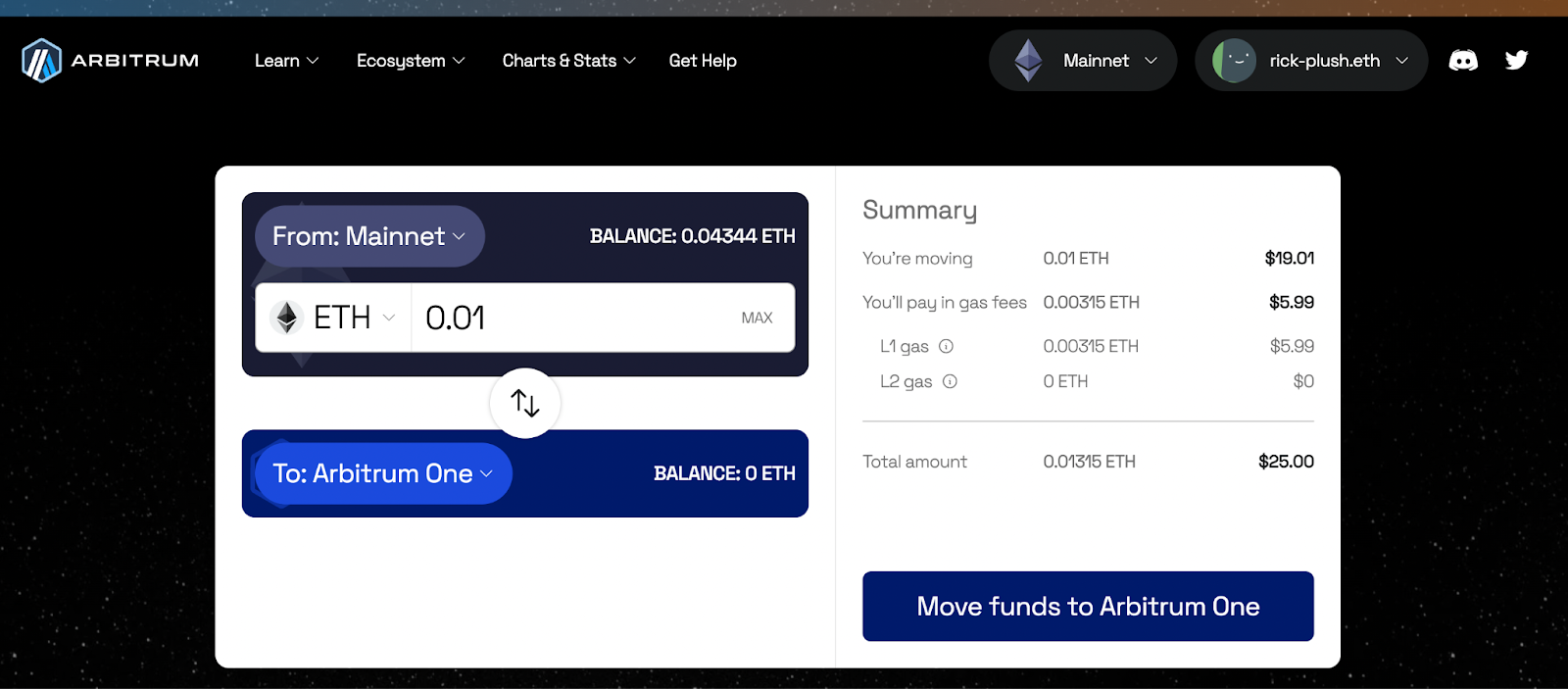
That’s it! You have successfully transferred your assets from Ethereum to Arbitrum One. The process for withdrawing assets follows the same steps, with the only difference being the selection of the “From” and “To” networks.
In conclusion, Arbitrum Ecosystem has emerged as a promising Layer 2 (L2) solution within the Ethereum ecosystem. It offers significant improvements in transaction speed and cost-effectiveness, addressing the scalability challenges faced by the Ethereum network. Since its launch, Arbitrum has experienced impressive growth, attracting a diverse range of projects and establishing itself as one of the top players in the cryptocurrency world.
However, it is crucial to acknowledge that Arbitrum faces stiff competition from platforms like Polygon and Optimism. Polygon’s higher transaction speed and independent consensus mechanism, coupled with Optimism’s compatibility with Solidity, pose significant challenges to Arbitrum’s quest for dominance.
While Arbitrum has unique advantages, such as its AVM and seamless compatibility with Ethereum, it still has room for further development and refinement. It needs to address these challenges head-on and continue to innovate to secure its position as the go-to solution for scaling Ethereum effectively. It will be fascinating to see how it evolves and competes against its rivals in the race to become the number one project for scaling Ethereum.
Mighty Block is one of the partners of Forte, a platform to enable game publishers to easily integrate blockchain technologies into their games. We believe blockchain will enable new economic and creative opportunities for gamers around the world and have assembled a team of proven veterans from across the industry (Kabam, Unity, GarageGames, ngmoco, Twitch, Disney), as well as a $100M developer fund & $725M funding, to help make it happen. That’s where you come into play.
Feel free to browse all our current open job opportunities in the following link 👇

At Mighty Block, we believe in the power of core values. They are the compass that guides us through our work and interactions, shaping our company startup culture. In a previous article, we introduced “How we create our culture and values”.
Today, I want to take you on a journey behind the scenes and share how our team plays a vital role in shaping them.These values are important to us because they reflect our commitment to excellence, innovation, and teamwork. We believe that these values will help us to achieve our goals and build a successful company.
Our core values go beyond being a mere checklist; they are the fuel that drives our organization forward and we bear the responsibility of setting the tone by exemplifying these values through our own actions. It shows all how to make difficult decisions that align with our core values, recognizing and rewarding those who consistently embody them, and ensuring that we hold ourselves and our team accountable whenever we fall short.
When core values are at the heart of our organization, they become a total game-changer in attracting the right people. It draws in the right people, while making the wrong ones stick out like a sore thumb.
It’s as simple as this: when you’re surrounded by a team who shares the core values, you thrive in an environment that feels like home, where everyone just clicks and works together seamlessly.
On the contrary, those who do not align with them become easily noticeable, feeling out of place and ultimately exiting the company. Simple—the right people thrive in an environment that shares the same core values.
As an example of guiding, when recruiting candidates at Mighty Block, we asked ourselves who represented better each of our values, giving us the advantage to get not only the more qualified candidates but also those who share our same startup culture. Resulting an immediate alignment and full involvement of each new member.
The journey of shaping our core values begins with clear identification and articulation. We must communicate our values in a way that is simple, memorable, and actionable. The remarkable aspect of our core values is that they were not imposed from the top down; they emerged from within our team.
To make this happen, we’ve got our very own core values ambassadors. Not just a phrase in the bord but someone in real life that represents it.
We came up with a monthly recognition program. We shine a spotlight on specific situations where one of our team members has seriously gone above and beyond to live out one of our core values. We’re talking about real-life examples of someone who’s totally owning it, day in and day out. By doing this, we not only celebrate their awesomeness, but we also show how much these core values matter to us as a team.
So if you were to ask anyone about our values, they’d instantly think of someone on our team who represents it. It’s like having your own personal mentor or guide for each and every value.Once we’ve got that level of clarity and personal connection, most of the work is done. Our core values become more than just some abstract concepts—they become our guiding compass for making decisions and tackling challenges. It’s like having a compass that always points us in the right direction. Every single member of our team can rely on these core values to guide their actions because we all understand and embrace them, its a teamwork effort of our startup culture.
it’s not just about having a fancy list of values. It’s about infusing them into our team’s DNA and making them a part of everything we do.
With our incredible core values ambassadors and the power of recognition, we’re building a strong startup culture where these values truly come alive. It’s been quite a journey, but it’s worth every single step.
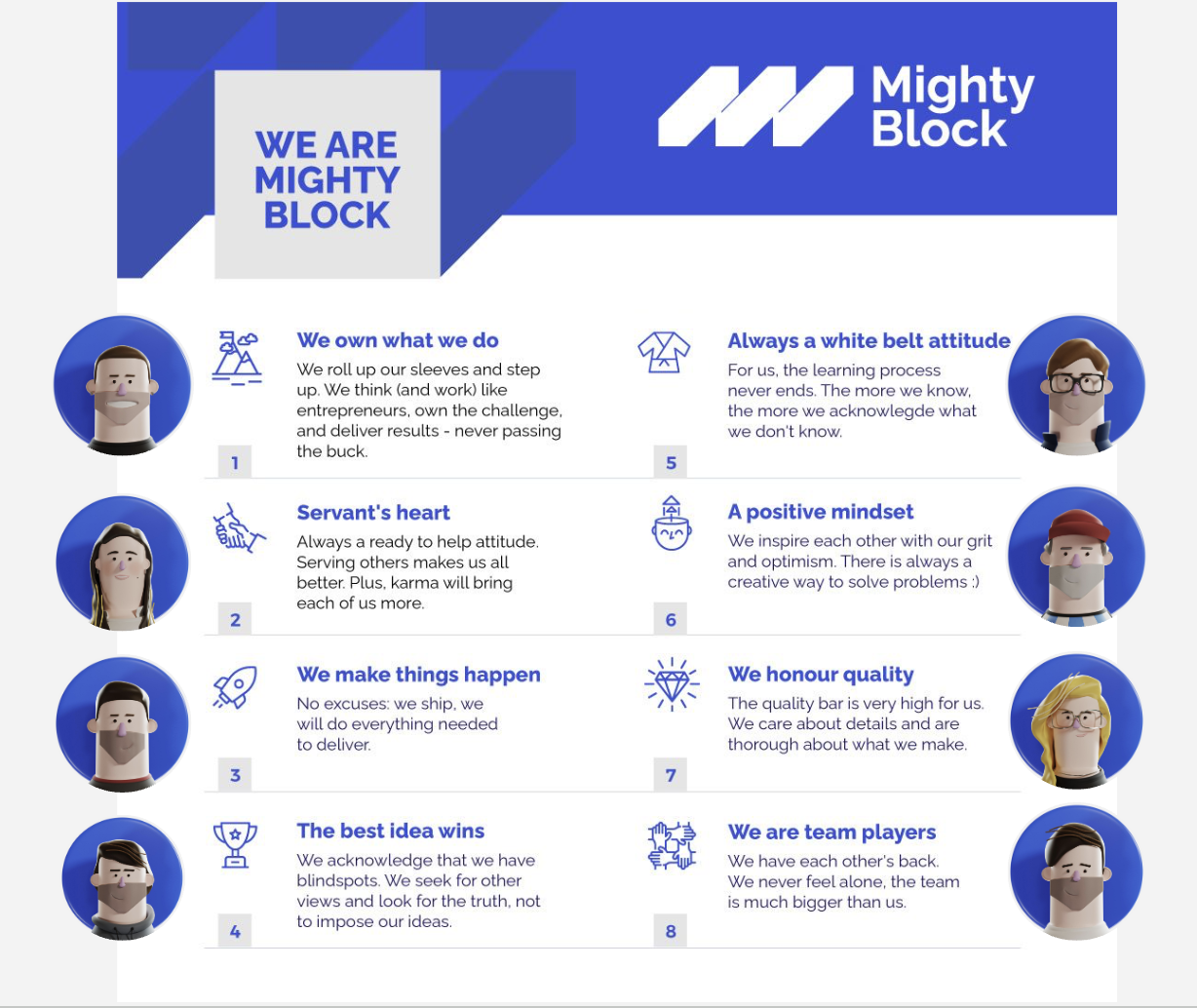
When our team fully embodies the core values, it becomes our responsibility to nurture and care for them. It’s not just about leaving it at that. This responsibility falls on all of us, not just a chosen few.
Whenever we have a question or face a challenge, we can always turn to them for some solid guidance. They’re our compass, pointing us in the right direction when we need it most.We’ve gotta foster our startup culture where making tough decisions and embracing discomfort becomes second nature. That’s how we build a team that’s always ready to take on whatever comes our way.
Understanding our team’s core values provides us with a distinct advantage—it enables us to empathize with our team members on a whole different level. This understanding is key to meeting their needs, predicting challenges before they arise, and making good decisions.
When companies lack core values or fail to uphold them, working in alignment becomes difficult, leading to missed opportunities and poor working environment.
Caring a startup culture starts by hiring the right people, caring for team members, leading by example, acknowledging people’s achievements, building relationships, and establishing missions and goals.
In my experience, shaping our core values was an extraordinary exercise. It became one of the most crucial processes on my agenda, and the outcome was nothing short of thrilling. Aligning the team to the startup culture, shared by all and demonstrated daily as examples of what is right, has transformed my way to operate. With this alignment, we witness tasks being accomplished with remarkable ease and exceptional quality.
Personally, one of the most significant tasks I’ve undertaken is getting to know the unique characteristics and values of each team member and sharing with them the collective responsibility of safeguarding our core values. This process has allowed us to foster an environment of openness and honesty, enabling us to collaborate more effectively as a cohesive unit. I can’t emphasize enough how fulfilling it is to witness the positive impact of working together towards a shared vision.
To guide us in this journey, we have adopted the EOS methodology. This methodology emphasizes the importance of combining core values and core focus to create what is referred to as the “Company Soul.” According to EOS, companies with strong core values and focus not only perform better but also possess a unique “X” factor that leads to success. At Mighty Block, we are creating our own Company Soul—a collective essence that drives us forward.

The team at Mighty Block truly understands the significance of shaping and nurturing our core values. They are not mere words on a board but rather the guiding principles that define us. By leading by example and fostering our startup culture of accountability, we attract and retain exceptional talent that aligns with our values. They have become an intrinsic part of our decision-making process and have empowered us to tackle challenges with confidence.
As we continue on our journey, we look forward to the merging of our core values and core focus to forge our Company Soul . I invite you to join us on this adventure as we write the next exciting chapter in the Mighty Block story.
Mighty Block is one of the partners of Forte, a platform to enable game publishers to easily integrate blockchain technologies into their games. We believe blockchain will enable new economic and creative opportunities for gamers around the world and have assembled a team of proven veterans from across the industry (Kabam, Unity, GarageGames, ngmoco, Twitch, Disney), as well as a $100M developer fund & $725M funding, to help make it happen. That’s where you come into play.
Feel free to browse all our current open job opportunities in the following link 👇
It’s common to hear about web3 initiatives incorporating or aiming to incorporate ZK-proofs for increased privacy. The notion of Zero Knowledge proof (ZK-proof) is not a modern concept; it was first introduced in a paper named “The Knowledge Complexity of Interactive Proof-Systems” in 1985. In this article we will see what a ZK-proof is, offer an intuitive explanation and explore several use cases.
Whether you are a developer or a user, it’s important to understand the core concept behind ZK-Proofs because it will help you understand not only what the product is trying to achieve in matters of security and privacy but also how they are trying to achieve them.
ZK-Proof is protocol that involves a Prover and a Verifier and enables the Prover to demonstrate the truth of a statement to the Verifier without disclosing any additional information beyond the veracity of the statement. Essentially, it allows the Prover to prove to the Verifier that they possess knowledge of a specific piece of information, without disclosing it.
The Ali Baba cave is a well-known story used to give an intuitive explanation of how the ZK-Proof protocol works. This story is based in a circular cave with one entrance and a magic door opened by a password located in the middle of it. It involves two actors, Bob the verifier and Alice the Prover.
Alice wants to prove to Bob that she knows the password that opens the door placed inside the cave without telling him the word itself. To do that they follows three simple steps:

If Bob screams A, and Alice returns using A it can mean two things: either Alice entered the cave through B and knows the password or entered through A and cheated. After all, there is a 50% chance of getting it right.

The key is to iterate this process until it becomes highly improbable for Alice to have cheated in every repetition, given that each time Alice is correct, the probability of cheating is halved.
Any scenario where someone needs to demonstrate the validity of some statement without giving up the information that validates it is suitable. In web3, ZK-Proofs can enhance privacy. For instance, they can be used to anonymize transactions between peers, as done in the ZCash z-address to z-address transactions, or to enable anonymous voting for decentralized autonomous organizations (DAOs).
Given the fact that the ZK-Profs are a general cryptography concept, applications can also be found for web2: financial institutions could leverage ZK-Proofs to demonstrate that a person’s income falls within a specific range, without disclosing the precise income amount or or as a proof of identity, demonstrating that the possession a valid government issued document, without giving it up.
ZK-Proofs are perfect for this kind of scenario because they can provide strong privacy guarantees without compromising the integrity of the data managed by the system.

Zero-Knowledge proofs have the potential to make the web3 space a more private and safer environment for the users. But as Uncle Ben said in the best Spider-Man movie: “with great power comes great responsibility”. We can’t ignore the fact that these tools can also be used by bad actors to perform illicit activities such as money laundering and illegal transactions. As we continue to develop and apply this technology, it is crucial to consider methods for combating its misuse without sacrificing its benefits. As web3 enthusiasts and developers this can’t be ignored and should be discussed along with the development of ZK-Proof based solutions.
Mighty Block is one of the partners of Forte, a platform to enable game publishers to easily integrate blockchain technologies into their games. We believe blockchain will enable new economic and creative opportunities for gamers around the world and have assembled a team of proven veterans from across the industry (Kabam, Unity, GarageGames, ngmoco, Twitch, Disney), as well as a $100M developer fund & $725M funding, to help make it happen. That’s where you come into play.
Feel free to browse all our current open job opportunities in the following link 👇

San Francisco, CA
[email protected]
©2022 MIGHTY BLOCK — All rights reserved


