Category

Begginers

5 Key Web3 Trends in 2024

Web3 trends

2023 is behind us, and as we step into the new year, we’re faced with a fresh set of opportunities. The past year, dominated by a bear market, was a real test for the web3 ecosystem. We witnessed many projects struggling to stay afloat, while others not only survived but thrived by adding real value to the ecosystem. As we look ahead to 2024, it’s clear that the experiences of the past year have set the stage for new trends that are about to unfold. In this article, we’ll explore five key web3 trends that every product manager in the ecosystem should be aware of.

The year of identity

Identity - Dall.e

Identity – DallĀ·e

2024 is poised to be a crucial year for digital identity. For product managers working on services or applications that require authentication, focusing on decentralized identity management will be essential. This approach puts users in control of their data, allowing them to share only what is necessary for an application’s functionality. We can also expect a rise in the use of verifiable credentials, with Zero Knowledge proofs (ZK proofs) enabling the sharing of proof without revealing the underlying data. 

The benefits of decentralized identities and verifiable credentials are significant for both end-users and organizations. 

  • End-users gain ownership and control over their digital identities, enhancing their privacy. 
  • For organizations, these technologies enable quick verification of information, fraud prevention, increased data security, and reduced risk of cyber attacks, as sensitive data is not stored in their systems

This web3 trend extends beyond the domain of web3 developers and organizations. Public sector advancements are also evident:

In Switzerland, Partisia Blockchain and the University of Applied Sciences and Arts Western Switzerland (HES-SO Valais-Wallis) are collaborating on a decentralized electronic identity system, focusing on privacy and individual data control​​. Meanwhile, China is advancing its blockchain ambitions with the RealDID initiative, aiming to create a national-level real-name decentralized identity system​​. These developments reflect a global move towards more secure and user-controlled digital identities
If you are an Spanish speaker, i strongly recommend you this podcast from our Mighty Block series: ā€œDescentralizando la identidad con web3ā€

Regulatory Compliance and Governance

Regulations – DallĀ·e

Regulatory aspects, especially concerning the SEC and ETFs, are becoming increasingly important in the web3 space. As the industry matures, adherence to regulatory norms and governance standards is crucial for ensuring sustainable growth and user trust. Many countries already have some regulations or guidelines for Crypto space. 

Recent regulatory developments underscore this trends:

  • The European Union’s Market in Crypto Assets (MiCA) Regulation entered into force in June, with a final consultation on Europe-wide regulations to be published early in 2024, and member state mandates taking effect in 2025.(1)
  • Hong Kong released new guidelines for virtual asset trading platform operators in June 2023.(1)
  • Namibia passed its Virtual Assets Act in last July, with regulations pending.(1)
  • Last September, the New York Department of Financial Services (NYDFS) released proposed updates to its framework for token trading businesses to trade tokens and a changed framework for how it would put tokens on its ā€œgreenlistā€ (1)
  • Also in September 2023, Dubai’s Virtual Assets Regulatory Authority released regulations on virtual asset activity.(1)

For product managers in the web3 ecosystem, staying informed and compliant with these evolving policies and regulations is a must. It’s not just about creating secure experiences; it’s also about safeguarding our end-users from potential risks and ensuring our services align with this new regulatory landscape.

NFTs reloaded 

Bored Ape Reload for 2024 - DallĀ·e

Bored Ape Reload for 2024 – DallĀ·e

The NFT landscape in 2023 saw a slowdown, with collections like Bored Ape Yacht Club and Azuki Elementals experiencing significant drops in value. Marketplaces such as OpenSea and Blur responded to this bear market by reducing to try to maintain the interest on people and capture market share

In 2024 the expectation looks more promising, expanding NFT scope beyond just art. A key area of growth is in gaming, which, despite being in the early stages of web3 development, is increasingly integrating NFTs. These digital tokens are an essential part of gaming, providing players ownership of in-game assets, which can then be collected or traded in secondary markets.

As for projections, Blockworks suggests significant growth in the web3 gaming sector,

  • At least 2x growth in Web3 games overall (according to Jon Jordan’s Big Blockchain Games List, there are currently 1,037) as of Dec. 19, 2023. (2)
  • At least 3x growth in fully on-chain games (according to Jon Jordan’s Big Blockchain Games List, there are currently 54) as of Dec. 19, 2023. (2)

Even if this is not as evolved as gaming, other usage is traceability of physical assets. The transparent blockchain ledger effectively tracks the ownership history of an NFT, bolstering authenticity and provenance.

Consequently, NFTs stand poised to revolutionize the realm of real-world asset ownership and management. In the future, utilizing NFTs could span a wide spectrum of assets, such as art, collectibles, real estate, and even securities.

Web3 onboarding using web2 scalable solutions

Onboarding from web2 to web3 - DallĀ·e

Onboarding from web2 to web3 – DallĀ·e

To truly mainstream web3 and welcome the next billion users, it’s crucial we shift our focus towards a wider audience. Sure, in the web3 space, we’re all about privacy and security – the whole ‘not your keys, not your assets’ mindset. But let’s be real: this appeals more to the early birds and tech enthusiasts who are willing to dive deep. 

To grow our ecosystem and make it robust, our game plan should include attracting people, guiding them step-by-step, and gradually unveiling the myriad possibilities of web3.

This year is going to be all about seamless onboarding. As product managers, we need to analyze the onboarding process. How can we borrow and adapt what worked in web2 to make web3’s decentralization more gradual and user-friendly? Our goal here is to ensure our users feel at ease and build confidence in navigating through this new tech landscape. 

Blockchain meets AI? 
The Blockchain meets the AI - DallĀ·e

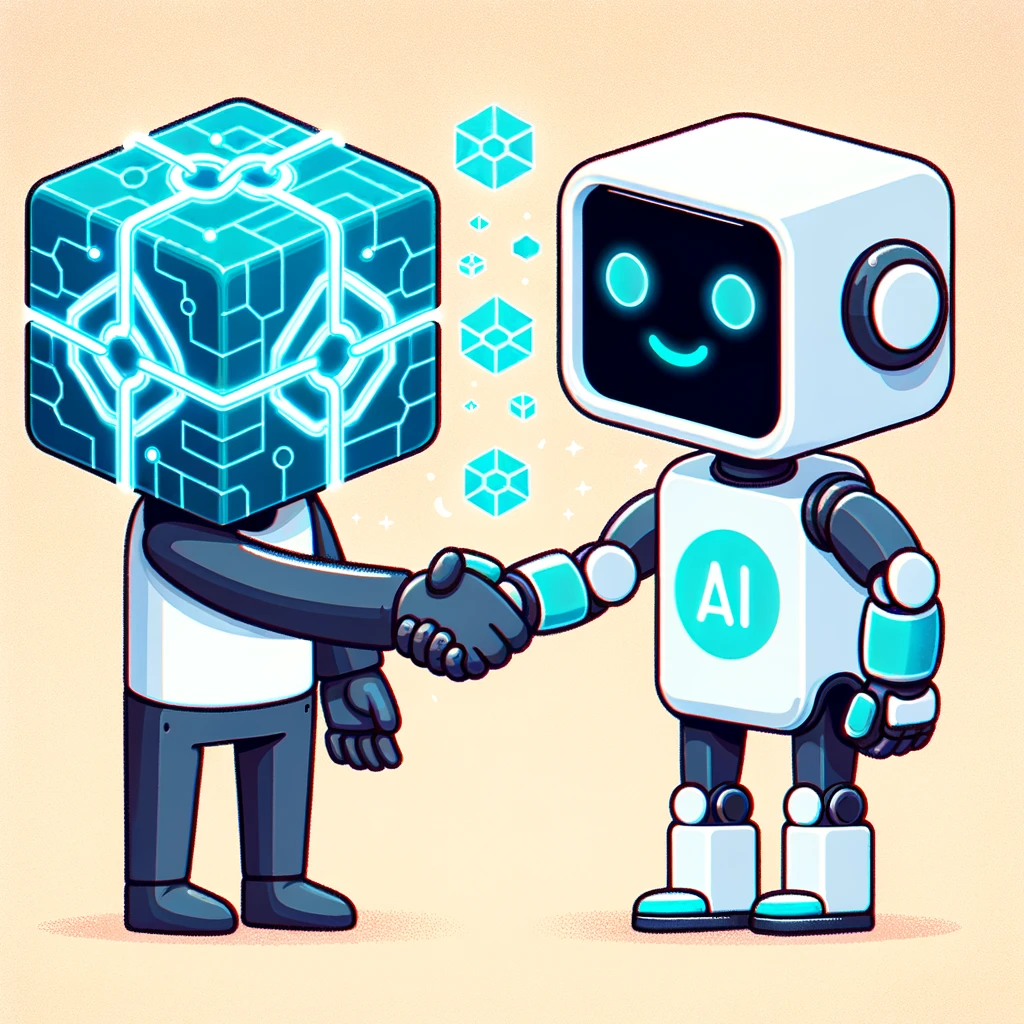
The Blockchain meets the AI – DallĀ·e

2023 was, without doubt, the year of AI. When this phenomenon appeared in our lives, we started to think about how to collaborate with the decentralized ecosystem. Is blockchain and AI something that naturally is going to work together? According to Vitalik, in the Podcast La Ultima Frontera, ā€œ…A lot of people want to be a connection and it’s sometimes hard to find a really big and deep one. There are definitely some smaller ones, for example ZKML (Zero Knowledge Machine Learning)ā€ 

Does this mean that as Product Manager we don’t need to worry about this? Well, actually the IA is an incredible tool to help us to improve our products, accelerating the research, helping to brainstorm, or as a simple assistant in our daily operative tasks. So even if there is not an immediate correlation between web3 and AI, is definitely one between what we can achieve using this tool to enhance the ecosystem with our products.

Web3 trends Takeaways

In summary, 2024 for web3 Product Managers is about embracing innovation responsibly, focusing on user empowerment, navigating the evolving regulatory environment, broadening the utility of NFTs, simplifying onboarding, and exploring the synergies between AI and blockchain; to create a safer, more inclusive, and vibrant web3 ecosystem.


(1) Source: Bloomberg Law 2024 – Regulatory & Compliance

(2) What to expect for Web3 in 2024

The best time management framework for makers

Time Management

Organizations spend roughlyĀ 15%Ā of their time on meetings, with surveys showing thatĀ 71%Ā of those meetings are considered unproductive. Unproductive meetings cost around 37 billion dollars per year, and 24 billion dollars are lost in work hours. One reason programmers dislike meetings so much is that they’re on a different type of schedule from other people. Meetings cost them even more. When you’re operating on the maker’s schedule, meetings are a disaster. A single meeting can blow a whole afternoon, by breaking it into two pieces each too small to do anything hard in. Plus you have to remember to go to the meeting.Understanding this made us realize that we needed a new way of managing our teams’ time at Mighty Block.

zippia.com

So, we used the following questions as a guideline to create a time management for our software developers team framework:

  • How do I reach my peak productivity?
  • Is multitasking effective?
  • How to avoid distractions and manage time efficiently?
  • What’s the best way to organize my schedule?
  • What to do with goal-less meetings?
  • How to handle meetings where I see no value?
  • How to prevent distractions and stay focused?

Limitations of body & mind

Before diving into the framework we designed, it’s important to understand how our mind works, what’s possible and what’s not.

This section is important because it’s common to read, specially in Twitter/X, about the Hustle Culture, the mentality that one must work all day every day in pursuit of their professional goals. However, we must acknowledge that when we are not connected to our body and emotions, we are at risk of burning out.

Is multitasking effective?

Multitasking Myth

Multitasking reduces cognitive capacity

What our brains are doing when we multitask is rapidly switching between tasks. This constant switching taxes our brain. It essentially tires it out and makes it less efficient. This particularly affects our ability to focus our attention in general, even when we are not multitasking. 

Multitasking makes us more distractible and prone to errors. For example, individuals rated as high media multitaskers (number of hours using multiple devices simultaneously, such as watching TV while also using a smart phone or tablet) showed poorer attention on cognitive tasks. 

Those individuals had to use more of their brain to complete the same task compared to low multitaskers. When you need to recruit more of your brain to complete a task, it means your brain is working less efficiently.

Multitasks
Multitasking: Why Your Brain Can’t Do It and What You Should Do About It – MIT

Daily cognitive budget

As Sam Altman explains in this interview, there is a daily cognitive budget of 8 high quality hours we can use before the output quality starts to decline. Put in another way: no human being can spend more than 8 hours in a day working at a high performance.

Sleep

According to the sleep researcher Matt Walker, only 1-3% of the population can operate normally with only 4 hours of sleep. Unless you are in this privileged group, you need at least 7 hours of good sleep per night.

In case you are curious on how to improve your sleep habits, check out this article.

Sleeps elite

A prioritization framework

Once we have improved our performance related to both body and mind, we can begin to think strategically about how we manage our time.

This time management framework for software developers was created based on reading, iterations, and collective experiences of the team (although we think it’s useful for any modern worker).

Prioritization framework

1. Get the important things done

  • There should never be more than 2 mission-critical items to complete each day. 
  • Do them separately from start to finish without distraction
  • Extreme focus blocks (minimum 2 hours)

2. Don’t waste time

In this modern age, we are bombarded all day long, specially from Monday to Friday, by companies using multiple channels to capture our attention. Additionally, content is getting more and more addicting and our dopamine system is being hacked.

Take a look at this list:

  • Checking email in real-time
  • Receiving WhatsApp, Signal, Telegram, SMS notifications from groups, family, co-workers and sales representatives
  • “Breaking News” that seem to be important (99% of the time they are not)
  • TikTok videos
  • Tweeter drama
  • Instagram stories
  • This list is endless…

3. Make lots of lists

We highly recommend making lists. Lists keep you focused, and you can review them periodically, reminding yourself of what’s important (and what’s not). They free up space in your mind—fewer things to memorize.

  1. Of the 3 tasks I need to finish today
  2. Of my goals for the quarter
  3. Of my goals for the year
  4. Of the books I want to read this year
  5. Of the goals with my partner

Lists keep you focused; you can review them anytime.

Additional tip! Visual Setup

  • The browser tabs are your best friend.
  • When focused on a Google Doc, keep it open, collapse the rest into groups.
  • While in a Goole Meet, leave it open, collapse the rest.
  • While coding, maximize the IDE, minimize the rest.
  • Disable desktop notifications for Slack, Email, WhatsApp.
  • Close WhatsApp web when focused on Meet, Google Doc, Coding.

Meetings: Do Them Right or Don’t Do Them at All

If within your role, you still have to organize or attend meetings, there are some rules that can help make them more efficient and productive. However, it’s important that you adhere to and encourage the team to follow them as well.

Meeting tips

meeting tips

L10 meeting: an efficient format for management roles

As part of the Entrepreneurial Operating SystemĀ® (EOSĀ®), the Level 10 Meeting (L10) creates a standard structure for productive meetings. No, really. EOS lays out a template for team meetings to focus on the most important things each week without the nonsense.

On a scale of 1 to 10, most people would rank their current meetings at a 4 or 5. In some cases, even that’s being generous. In a Level 10 Meeting, attendees focus on the most important topics to spot issues before they become bigger problems. But that doesn’t come naturally (as evidenced by the prevalence of crappy meetings). To get there, companies Running on EOSā„¢ use the standardized L10 agenda.

What makes a L10 meeting so effective?

Because Level 10 meetings operate at a repeatable, strategic level, they provide a solid framework covering material that matters. Opinions and politicking have no place in a meeting that focuses strictly on objectives and metrics. Teams also learn to minimize tangents and sidebar conversations to cover only what matters.

In addition, the same two individuals (or their proxies during vacations) serve as the facilitator and the scribe for every meeting. This removes the question, ā€œWho’s leading this meeting?ā€ The same goes for the scribe role: Everyone already knows who’s taking notes. Removing this ambiguity saves precious minutes discussing and agreeing to roles in each meeting.

If you are interested in learning more about L10 and EOS, check out this article.

Please let us know if you enjoy this time management tips for software developers!

L10: The most efficient meeting

Building a Start Up Culture of Growth

Building a start up

In this article, we aim to share our approach to personal development and the cultivation of a robust start up culture, which has transformed us into a high-performance team deeply rooted in our core values.

With the management team, we had a vision: a high-performing team with strong bonds that would enable us to uphold open and honest communication. It may sound like a lot because it wasn’t a feature we could simply develop and consider “done”; it required us to embrace learning and experience some discomfort.

Core concept for a start up culture

We selected the concept coined by Carol Dweck, the ‘Growth Mindset,’ as the central theme for the year. 

In essence, the concept introduced by Carol Dweck can be summarized as follows: Individuals who believe in the potential for their talents to develop through hard work, effective strategies, and input from others possess a growth mindset. They tend to achieve more than those with a fixed mindset who believe their talents are innate gifts. This is because those with a growth mindset worry less about appearing intelligent and invest more energy into the process of learning.

When entire companies embrace a growth mindset, their employees report feeling significantly more empowered and committed. Additionally, they receive increased organizational support for collaboration and innovation. In contrast, individuals in companies primarily rooted in a fixed mindset tend to report more instances of cheating and deception among employees, presumably as an attempt to gain an advantage in the talent competition.

Fixed Mindset vs Growth Mindset
source: lifehack.org


We chose this concept to serve as our guiding principle whenever our team faced an obstacle. The first thing we did was to share it with the team and reinforce it in every conversation opportunity. When designing the training for team leads, we knew it was crucial to rely on this concept to implement the changes and improvements we envisioned for our ‘Clarity Break’ training.

Victim or player?

But how did we first come to embrace this concept? We have a Friday tradition that has been with us since the first day of Mighty Block: Crypto Research. Originally, it was a forum where we discussed various topics related to crypto that had been researched. This was crucial in the early days of the company when the crypto industry was rapidly expanding, and our team was relatively new to blockchain. It was essential to stay updated on all the latest developments.

However, recently, it became tedious to find a NEW topic for research related with crypto. We would prepare it without enthusiasm, procrastinate, and so on.

Viktor Frankl

To address this issue, we began to contemplate the two models, framed by the ‘victim vs. protagonist’ dichotomy introduced by Freddy Coffman. What does a victim do when they don’t like Crypto Research? They complain, get frustrated, and kick it – were some of the responses we received. 

On the other hand, as protagonists, we seized an opportunity during a workshop we held in Cordoba. Together, we designed a new format, made commitments, and implemented the change. We would no longer confine ourselves to a single topic (crypto), but instead, we would include subjects that positively impact our daily lives. Additionally, we could invite guests and introduce special editions featuring panel discussions. Change the name help us to not limited ourselves and give to  ā€œthe mighty showā€ a new beginning

Cordoba Workshop 2023
The team working in Cordoba Workshop

Open and Honest Feedback

In order to learn from each other, take more risks, and grow as a team, we needed to ensure that we had the skills to provide feedback in an open and honest manner. That’s why it was essential to dedicate time during the workshop we held in Buenos Aires to discuss those ‘monsters’ that make us hesitant when it comes to giving feedback.

Feedback monsters
The monsters Mb team draw

Fears of having to take on extra tasks, fear of hurting someone else’s feelings, fear of being wrong in my assessment, among others – identifying these fears helped us. We created actions in collaboration with the leads to ‘combat’ them and encourage each other to embrace the open and honest mindset. Later, during a virtual discussion, we explored the best tips for effective communication when giving feedback. We reviewed do’s and don’ts to enhance our feedback process.

Learning from Mistakes

Mistakes are a fundamental source of learning in a start up culture, and we’ve been discussing what happens to us when we make mistakes, the emotions and feelings we experience, and how we can make the most out of our errors. In a special session of our Friday ā€œMighty Block Showā€, we learned that the key to evolving from the traditional concept of failure is not to view success and failure as a binary but to incorporate them into the learning process.

We shared our experiences with error and took away some key insights: When we’re trying to resolve an error, it’s beneficial to take a moment to clear our minds, seek help, and breathe. When someone shares a problem or mistake they’ve encountered, it’s essential to assist and make them feel comfortable and supported. We emphasized not getting caught up in the mistakes – they don’t define us.

John Wooden - mistakes

Strong Growth Workshop – Key Takeaways

At our start up culture, we have a unique tradition. Every quarter, we come together as a team for an entire week. During our recent gathering, we revisited the invaluable lessons we’ve learned throughout the year.

With the theme of ” Strong Growth” in mind, we approached our learning experience in a playful way. We incorporated various games to enhance our understanding of these lessons. We recognized that mistakes are an integral part of the learning process; they are the stepping stones to success. We also acknowledged the value of maintaining a player’s attitude – being open to new challenges and eager to explore uncharted territories. We also learned that frustration and expectations often go hand in hand. By acknowledging this fact, we can navigate our professional journeys with greater resilience and a clear perspective.

One of the most exciting outcomes of our learning journey was the construction of a Jenga tower. This tower, where each block represented our learnings and experiences, serves as a symbol of our team’s commitment to growth and our evolving organizational start up culture. It visually represents how we stack our achievements, learn from our failures, and build a stronger and more resilient team.

Start up culture learnings
Mighty Block learning tower

Incorporating playful learning into our professional development has not only made our quarterly gatherings more enjoyable but has also proven to be an effective way to drive our team’s personal and collective growth. We look forward to the upcoming quarters with renewed enthusiasm, ready to embrace the challenges and successes!

Check out this video with our experience in the last workshop.

Web3 Tech Stack for Developers

Web3 stack

When you start your career as a web3 developer, you may need a guide on the main tools. At Mighty Block, we’ve put together this Web3 Tech Stack, which can be a good option to get started.
What do you think? Would you add anything? Would you remove anything?

Web3 Tech Stack for devs

Web3 Explained Simply: A Blog Series

Web3 explained simply

Welcome to our series of introduction to Web3 blog articles. Web3 is the cutting-edge realm of the internet that’s reshaping the way we interact, transact, and innovate online.

If you’re an enthusiast, a curious newcomer, or a seasoned developer looking to dive into this world, our guide to Web3 is designed to provide you with a foundational understanding and a roadmap for your journey.

This is the first article, specially designed like a beginners guide to Web3. In upcoming editions, we will bring more advanced content šŸ”„

The Road to Web 3

šŸ›¤ļø Introduction to Blockchain Get started with the basics as we unravel the key concepts behind blockchain technology, the foundational pillar of Web3, and explore how it’s transforming the digital landscape.

Web3 Glossary

šŸ“˜Don’t let the terminology overwhelm you. Our glossary provides a handy reference to decipher the jargon and acronyms commonly used in the Web3 ecosystem. Because the best way of explaining Web3 is learning its vocabulary.
If you’re here to gain a foundational understanding of Web3 or to explore specific aspects in depth, our blog series aims to be your guide through this exciting and transformative digital landscape. Join us on this journey of exploration and discovery into the world of Web3.

Web2 to Web3

šŸš€ Join us on a journey from the traditional Web 2.0 era to the decentralized and user-centric Web 3.0 landscape, understanding the evolution and the reasons driving this revolutionary shift.

Ethereum 101

🌐 Delve into the world of Ethereum, one of the most influential blockchain platforms, and discover its significance in the development of decentralized applications and smart contracts. Web3 is blockchain based, and Ethereum is an authority to listen to.

Bitcoin 101

šŸ’°Uncover the mysteries of Bitcoin, the pioneer of cryptocurrencies, and learn about its impact on the financial and technological spheres. Bitcoin is in your crypto wallet and additionally through many aspects of life today.

šŸ” Explore the critical aspect of security in the Web 3.0 ecosystem, gaining insights into best practices, vulnerabilities, and strategies to safeguard your digital assets. You have to learn how to keep safe your personal data.

UX (User Experience)

🌈 5 UX aspects that a decentralized network needs to improve. The World Wide Web needs to be simple for users.

Product Management

šŸ“Š Discover the unique challenges and strategies involved in managing Web3 projects, from ideation to execution, and learn how to navigate this dynamic landscape.

The Web3 Developer Stack

šŸ› ļø For aspiring Web3 developers, we break down the essential tools, languages, and frameworks needed to create decentralized applications and smart contracts. Artificial intelligence plays a central role in this process.

The Road to Web3 and the Difference between Web2

Web3 road

One of the most common questions I get is, What is the difference between web2 and web3? What is Mighty Block doing to onboard users to web3 ? What is the road to web3?

As an introduction I gather information and wrote the following summary:

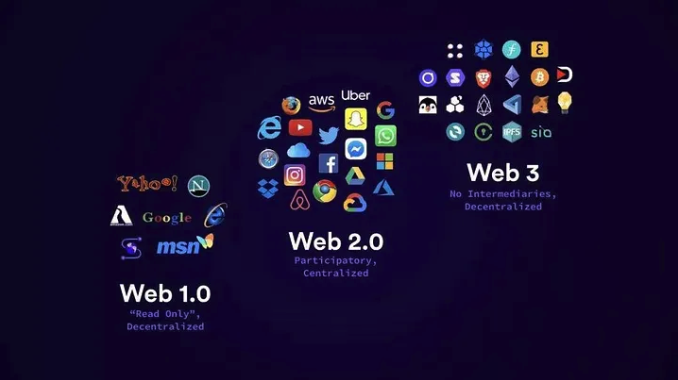
Web2 and Web3 are two different generations of the World Wide Web. Web2 is characterized by a stronger emphasis on user participation, collaboration, and sharing. In contrast, Web3 is characterized by a greater emphasis on decentralization, user control, and the integration of new technologies like blockchain and artificial intelligence.

Web2 has had a profound impact on the way we use the internet. It has made the web more interactive, collaborative and social. This has led to a wider range of possibilities for how we can use the web to learn, communicate, and share information.

Web3 is still in its early stages of development, but it has the potential to revolutionize the way we use the internet. It could make the internet more open, transparent, and democratic. It could also lead to the development of new and innovative applications that we can’t even imagine today.

So, what is the road to web3 from web2?

Let’s start with, what is web2

The term “web2” describes the second generation of the World Wide Web, characterized by a stronger emphasis on user participation, collaboration, and sharing. Web2 websites enable users to interact with both each other and the website content in a more meaningful way compared to earlier web technologies.

Some of the key features of web2 websites include:

  • User-generated content: Websites allow users to create and share their own content, such as blog posts, photos, and videos. Users can share this content with other users on the website, or they can make it public for anyone to see.
  • Collaboration: Websites allow users to collaborate with each other on projects and tasks. Features such as forums, wikis, and social media enable this.
  • Social networking: Websites allow users to connect with each other and form online communities. Users can accomplish this through features like social media, user profiles, and friend lists.

Some of the most popular web2 websites include:

  • YouTube: A video-sharing website where users can watch, upload, and share videos.
  • Facebook: A social networking website where users can connect with friends and family, share photos and videos, and join groups.
  • Twitter: A microblogging platform where users can post short messages, or “tweets,” to their followers.
  • Wikipedia: Volunteers edit a free online encyclopedia.
  • Google Docs: A cloud-based word processing application that allows users to collaborate on documents in real time.

Then, What is web3

Web3 represents the third generation of the World Wide Web, marked by a stronger emphasis on decentralization, user empowerment, and the incorporation of innovative technologies like blockchain and artificial intelligence.

Web3 is still in its early stages of development, but it has the potential to revolutionize the way we use the internet. Some of the key features of web3 include:

  • Decentralization: Decentralized networks build applications, which implies that no single entity controls them. This makes them more resistant to censorship and gives users more control over their data.
  • User control: In web3 applications, users have the capability to own their personal data and exercise control over its usage. This is in contrast to web2 applications, where users typically give up control of their data to the companies that provide the services.
  • New technologies: Applications use new technologies such as blockchain and artificial intelligence to provide new and innovative features. For example, blockchain can be used to create secure and tamper-proof records, while artificial intelligence can be used to personalize user experiences.

Web3 has the potential to make the internet more open, transparent, and democratic. It could also lead to the development of new and innovative applications that we can’t even imagine today.

Here are some examples of web3 applications:

  • Decentralized finance (DeFi): DeFi applications allow users to access financial services without the need for a central authority. For example, users can lend and borrow money, trade cryptocurrencies, and earn interest on their deposits without the need for a bank. The smart contracts have a principal role here.
  • Non-fungible tokens (NFTs): are digital assets characterized by their uniqueness and inability to be replaced. They serve as representations for a wide range of items, including artwork and in-game assets. NFTs are securely stored on the blockchain, making them resistant to tampering and ensuring their security.
  • The metaverse: Web3 developers are building the metaverse to allow users to interact with each other and with digital content in a more immersive way.
road-to-web3

Advantages and Disadvantages

Web2

Advantages:

  • User-generated content: web2 websites allow users to create and share their own content, such as blog posts, photos, and videos. Users can share this content with other users on the website, or they can make it public for anyone to see.
  • Collaboration: web2 websites allow users to collaborate with each other on projects and tasks. Users can do this through features such as forums, wikis, and social media platforms.
  • Social networking: web2 websites allow users to connect with each other and form online communities. Users can do this by using features such as social media, user profiles, and friend lists.

Disadvantages:

  • Data privacy: Web2 websites often collect users’ data, which can be used for advertising or other purposes. This can raise concerns about data privacy.
  • Security: web2 websites can be vulnerable to security attacks, which can lead to data breaches or other problems.
  • Censorship: web2 websites can be censored by governments or other organizations. This can limit the free flow of information.

Web3

Advantages:

  • Decentralization: Web3 developers build web3 applications on decentralized networks so that they are not controlled by any single entity. This makes them more resistant to censorship and gives users more control over their data.
  • User control: web3 applications allow users to own their data and control how it is used. This is in contrast to web2 applications, where users typically give up control of their data to the companies that provide the services.
  • New technologies: web3 applications use new technologies such as blockchain and artificial intelligence to provide new and innovative features. For example, blockchain can be used to create secure and tamper-proof records, while artificial intelligence can be used to personalize user experiences.

Disadvantages:

  • Early stage: web3 is still in its early stages of development, which means that there are a limited number of applications available.
  • Complexity: web3 applications can be complex to internet users, which could limit their adoption.
  • Security: web3 applications are still relatively new, which means that they may be vulnerable to security attacks. Even if they are blockchain based.
Featureweb2web3
User-generated contentYesYes
CollaborationYesYes
Social networkingYesYes
DecentralizationNoYes
User controlNoYes
New technologiesNoYes
Early stageNoYes
ComplexityNoYes
SecurityNoYes

Overall, web3 has the potential to be a more open, transparent, and democratic internet. However, it is still in its early stages of development, and there are a number of challenges that need to be addressed before it can reach its full potential.

What is the road to web3, what is needed?

There are a number of things that need to happen to build the road to web3, and in order to accelerate the process of moving from web2 to web3. These include:

  • Increased adoption of decentralized technologies: web3 is built on decentralized technologies, such as blockchain and peer-to-peer networks. Users and developers need to adopt these technologies in order for web3 to become mainstream.
  • Improved user experience: web3 applications can be complex and difficult to use. Developers need to make these applications easier to use to attract a wider audience.
  • Increased investment: web3 development is still in its early stages, and it needs investment in order to grow. This investment can come from governments, businesses, and individuals.

If these things happen, then the road to web3 will accelerate. web3 has the potential to revolutionize the way we use the internet, and it is important that we do everything we can to make it a reality.

Here are some additional things that could help accelerate the process of moving from web2 to web3:

  • Government support: Governments could support the development of web3 by providing funding for research and development, and by creating a regulatory environment that is favorable to decentralized technologies.
  • Industry collaboration: Businesses and organizations could collaborate to develop and promote web3 applications. This could help to create a critical mass of users and developers, which would make it easier for web3 to gain traction.
  • Public education: The public needs to be educated about the benefits of web3. This could help to create demand for web3 applications, and it could also help to address some of the concerns that people have about decentralized technologies.

The move from web2 to web3 is a complex process, but it is one that has the potential to make the internet more open, transparent, and democratic. By taking the steps outlined above, we can help to accelerate this process and make web3 a reality.

Challenges that need to be addressed before web3 can reach its full potential:

  • Security: web3 applications are still relatively new, and they may be vulnerable to security attacks.
  • Complexity: web3 applications can be complex and difficult to use. This could limit their adoption by a wider audience.
  • Regulation: Governments are still trying to figure out how to regulate web3 applications. This could slow down the adoption of web3.

Despite these challenges, web3 has the potential to revolutionize the way we use the internet. By addressing the challenges that need to be addressed, we can help to make web3 a reality.

Reasons why to move from web2 to web3:

  • Web3 has the potential to revolutionize the way we use the internet. Unlike web2, which is controlled by a small number of companies, web3 is decentralized, meaning that no single entity controls it. This decentralization can prevent censorship, address data privacy concerns, and promote innovation. This can lead to a more open, transparent, and democratic internet.
  • There is a growing demand for web3 solutions. The growing awareness of the benefits of web3 is leading to an increased demand for products and services built on web3 technologies. Several factors are driving this demand, including the surge in cryptocurrency usage, the expansion of the decentralized finance (DeFi) market, and the rising popularity of non-fungible tokens (NFTs).
  • The web3 market is still in its early stages of development. This means that there is a lot of opportunity to get involved and make a significant impact. The web3 market is also very capital-intensive, meaning that there is a lot of money available to fund startups that are working on web3 solutions.
difference-betweeb-web2-and-web3

At Mighty Block our focus is to help onboard the next billion users to web3 and we are building the road to web3 to do so.

Let me know if this summary has helped you understand the differences between web2 and web3 and has brought you one step closer to travel the road to web3 !

We are always looking for Web3 talent !

Mighty Block is one of the partners of Forte, a platform to enable game publishers to easily integrate blockchain technologies into their games. We believe blockchain will enable new economic and creative opportunities for gamers around the world and have assembled a team of proven veterans from across the industry (Kabam, Unity, GarageGames, ngmoco, Twitch, Disney), as well as a $100M developer fund & $725M funding, to help make it happen. That’s where you come into play.

Feel free to browse all our current open job opportunities in the following link šŸ‘‡

The Web3 Glossary

Web3 Glossary

The blockchain world can be overwhelming at first. Having a deep understanding of the basic concepts will help you better organize your learning process. Here are some definitions we have crafted to help you get started with, we introduce you: “The Mighty Block Web3 Glossary”.

(in alphabetical order)

Airdrop : Describes token distribution methods used for introducing new cryptocurrencies or tokens to specific wallet addresses. Web3 projects can use airdrops as marketing initiatives by facilitating airdrops to users completing tasks such as app downloads or referrals.

Altcoin:  Any of various cryptocurrencies that are regarded as alternatives to established cryptocurrencies and especially to Bitcoin.

Arbitrum: Arbitrum is an Ethereum layer 2 scaling solution that reduces fees and network congestion by computing transactions outside of the Ethereum Mainnet. Arbitrum’s rollups use multi-round fraud proofs to verify contracts were executed correctly. Blocknative currently does not support the Arbitrum L2 blockchain.

Arbitrum

Arbitrage: Arbitrage in the world of web3 is the same as in traditional finance and is a natural mechanism for markets to achieve equilibrium. Whereas arbitrage in the real world is usually possible due to differences in physical realities (the price of a widget is 20% higher in Country A than Country B), arbitrage in web3 is made possible by the value of assets within different web3 ecosystems. Consider a situation where the price of Ethereum is $2000 on Uniswap, but at the same time, it is $1990 on Sushiswap. An arbitrager can take advantage of this gap by buying ETH on Sushi to resell on Uniswap, instantly pocketing $10 per ETH (minus gas fees). Arbitrage is a key factor in MEV.

Blockchain: A blockchain is a distributed database that is shared among the nodes of a computer network. Blockchains store a continuously growing historical ledger of information (e.g. accounts and transactions) into blocks. Blocknative builds APIs for blockchain developers, including mempool monitoring tools, blockchain notification tools, and gas estimation tools.

Bridge: The list of essential terms in web3 would also draw attention toward bridges, which have emerged as promising answers to concerns of interoperability. The bridge is an effective tool tailored for transferring assets from one blockchain network to another. It is also important to note that all bridges do not feature the same design and have different functionalities.

Centralized Exchanges: Centralized exchanges have evolved as one of the popular applications in the web3 ecosystem with promising value advantages. Centralized exchanges are cryptocurrency exchanges run by third-party agencies to sell and buy cryptocurrency. One of the distinctive highlights of centralized exchanges is the fact that they are custodial in nature. Notable examples of centralized exchanges include Gemini, Kraken and Coinbase. 

Decentralized Exchange (DEX). This type of crypto exchange enables users to transact in a direct peer-to-peer manner without any intermediary

ERC: Ethereum Request for Comment is the proposal for modification to the Ethereum ecosystem, which has passed the approval stage. It points out a collection of standards used for a specific operation on the Ethereum network. 

Gas: Gas is a unit of measurement that represents the computational effort required to complete a transaction. How much a user spends to complete a transaction is determined by the total amount of gas multiplied by the gas price.

Gas Estimator: Gas Estimator is an ETH gas fee tracking tool built by Blocknative that inspects every pending transaction in Ethereum’s mempool to probabilistically estimate transaction fees to get included in the next block.

Gas Fees: Gas fees are the fees users must pay in Ethereum’s native currency, Ether (ETH), to complete a transaction. Gas fees are used to compensate miners for providing the computational work required to process and validate transactions.

Gas Price: The gas price is the amount of Ether (ETH) a user is willing to pay for every unit of gas required to complete a transaction (denominated in Gwei).

Layer 1: refers to the main blockchain in a multi-level blockchain network. For example, Ethereum and Bitcoin are layer one blockchains. Many layer two blockchain offload resource-intense transactions to their separate blockchain, while continuing to use Ethereum’s or Bitcoin’s layer one blockchain for security purposes.

Layer 2 (L2) refers to a secondary framework or protocol that is built on top of an existing, layer one blockchain. Layer 2 blockchains typically improve transaction speeds and cost efficiency. As Layer 2s continue to scale, mempool data gives builders looking to migrate or build new Dapps the tools to create the best user experiences.

Liquidity Pool: Is a smart contract containing large portions of cryptocurrency, digital assets, tokens, or virtual coins locked up and ready to provide essential liquidity for networks that facilitate decentralized trading.

Oracles: Are entities that connect blockchains to external systems, thereby enabling smart contracts to execute based upon inputs and outputs from the real world. Oracles provide a way for the decentralized Web3 ecosystem to access existing data sources, legacy systems, and advanced computations.

POH: Proof of Humanity (or PoH) is a social identity verification system for humans on Ethereum. PoH combines webs of trust, reverse Turing tests, and dispute resolution to create a sybil-proof list of humans.

Smart Contract: The smart contract is written in virtual language and has the power to execute and enforce itself, autonomously and automatically, based on a series of programmed parameters. With blockchain technology, its main value lies in reinforcing security, transparency and trust between signatories, avoiding misunderstandings, falsifications or alterations and dispensing with intermediaries.

Staking: Staking is the locking up of cryptocurrency tokens as collateral to help secure a network or smart contract, or to achieve a specific result. Staking is a term often used to describe the locking up of cryptocurrency as collateral to help secure a particular blockchain network or smart contract protocol

Swapping: An agreement between two parties that exchange different token types (say token š“ and token šµ). In a token swap, one party will pay a certain amount of token š“ to the other party and receive the agreed amount of token šµ in return.

Wallet: A Web3 wallet is a software program that stores private keys, which are necessary for accessing blockchain networks and conducting transactions. Unlike traditional wallets, which store physical currency, Web3 wallets store digital assets such as Bitcoin, Algorand, and NFTs.

Zero-Knowledge Proof: A zero-knowledge proof is a method of verification in which a “prover” shows possession of secretive knowledge to a “verifier” without revealing the sensitive information itself. This encryption scheme can ensure data privacy and confidentiality on a public blockchain.

ZK-Rollup: A ZK or “zero-knowledge” rollup is an Ethereum layer 2 scaling solution that bundles transactions off-chain into a single cryptographic proof. This transaction is then submitted back to the main chain for validation. ZK-rollups utilize validity proofs to confirm transaction legitimacy.

We are always looking for Web3 talent !

Mighty Block is one of the partners of Forte, a platform to enable game publishers to easily integrate blockchain technologies into their games. We believe blockchain will enable new economic and creative opportunities for gamers around the world and have assembled a team of proven veterans from across the industry (Kabam, Unity, GarageGames, ngmoco, Twitch, Disney), as well as a $100M developer fund & $725M funding, to help make it happen. That’s where you come into play.

Feel free to browse all our current open job opportunities in the following link šŸ‘‡

Startup Culture: The Driving Force Behind Mighty Block Success

Mighty Block - StartUp Culture

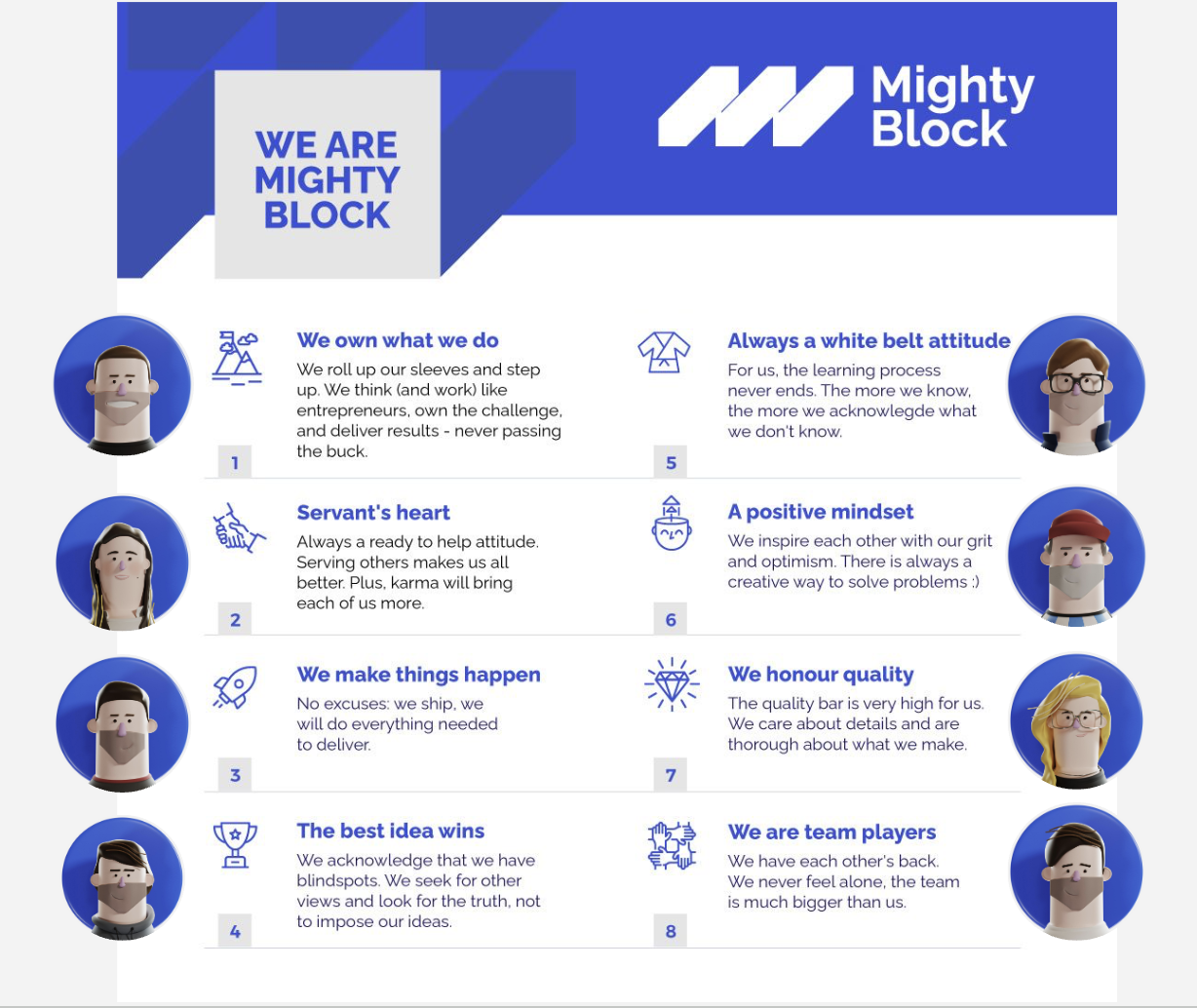
At Mighty Block, we believe in the power of core values. They are the compass that guides us through our work and interactions, shaping our company startup culture. In a previous article, we introduced ā€œHow we create our culture and valuesā€.

Today, I want to take you on a journey behind the scenes and share how our team plays a vital role in shaping them.These values are important to us because they reflect our commitment to excellence, innovation, and teamwork. We believe that these values will help us to achieve our goals and build a successful company.

Guiding Our Every Move

Our core values go beyond being a mere checklist; they are the fuel that drives our organization forward and we bear the responsibility of setting the tone by exemplifying these values through our own actions. It shows all how to make difficult decisions that align with our core values, recognizing and rewarding those who consistently embody them, and ensuring that we hold ourselves and our team accountable whenever we fall short.

When core values are at the heart of our organization, they become a total game-changer in attracting the right people. It draws in the right people, while making the wrong ones stick out like a sore thumb.

It’s as simple as this: when you’re surrounded by a team who shares the core values, you thrive in an environment that feels like home, where everyone just clicks and works together seamlessly.

On the contrary, those who do not align with them become easily noticeable, feeling out of place and ultimately exiting the company. Simple—the right people thrive in an environment that shares the same core values.

As an example of guiding, when recruiting candidates at Mighty Block, we asked ourselves who represented better each of our values, giving us the advantage to get not only the more qualified candidates but also those who share our same startup culture. Resulting an immediate alignment and full involvement of each new member.

Shaping Core Values: Where It Begins

The journey of shaping our core values begins with clear identification and articulation. We must communicate our values in a way that is simple, memorable, and actionable. The remarkable aspect of our core values is that they were not imposed from the top down; they emerged from within our team.

To make this happen, we’ve got our very own core values ambassadors. Not just a phrase in the bord but someone in real life that represents it.

We came up with a monthly recognition program. We shine a spotlight on specific situations where one of our team members has seriously gone above and beyond to live out one of our core values. We’re talking about real-life examples of someone who’s totally owning it, day in and day out. By doing this, we not only celebrate their awesomeness, but we also show how much these core values matter to us as a team.

So if you were to ask anyone about our values, they’d instantly think of someone on our team who represents it. It’s like having your own personal mentor or guide for each and every value.Once we’ve got that level of clarity and personal connection, most of the work is done. Our core values become more than just some abstract concepts—they become our guiding compass for making decisions and tackling challenges. It’s like having a compass that always points us in the right direction. Every single member of our team can rely on these core values to guide their actions because we all understand and embrace them, its a teamwork effort of our startup culture.

it’s not just about having a fancy list of values. It’s about infusing them into our team’s DNA and making them a part of everything we do.

With our incredible core values ambassadors and the power of recognition, we’re building a strong startup culture where these values truly come alive. It’s been quite a journey, but it’s worth every single step.


Caring for Our Core Values

When our team fully embodies the core values, it becomes our responsibility to nurture and care for them. It’s not just about leaving it at that. This responsibility falls on all of us, not just a chosen few.

Whenever we have a question or face a challenge, we can always turn to them for some solid guidance. They’re our compass, pointing us in the right direction when we need it most.We’ve gotta foster our startup culture where making tough decisions and embracing discomfort becomes second nature. That’s how we build a team that’s always ready to take on whatever comes our way.

Understanding our team’s core values provides us with a distinct advantage—it enables us to empathize with our team members on a whole different level. This understanding is key to meeting their needs, predicting challenges before they arise, and making good decisions.
When companies lack core values or fail to uphold them, working in alignment becomes difficult, leading to missed opportunities and poor working environment.

Caring a startup culture starts by hiring the right people, caring for team members, leading by example, acknowledging people’s achievements, building relationships, and establishing missions and goals.


The Magic of Aligned Values

In my experience, shaping our core values was an extraordinary exercise. It became one of the most crucial processes on my agenda, and the outcome was nothing short of thrilling. Aligning the team to the startup culture, shared by all and demonstrated daily as examples of what is right, has transformed my way to operate. With this alignment, we witness tasks being accomplished with remarkable ease and exceptional quality.

Personally, one of the most significant tasks I’ve undertaken is getting to know the unique characteristics and values of each team member and sharing with them the collective responsibility of safeguarding our core values. This process has allowed us to foster an environment of openness and honesty, enabling us to collaborate more effectively as a cohesive unit. I can’t emphasize enough how fulfilling it is to witness the positive impact of working together towards a shared vision.

To guide us in this journey, we have adopted the EOS methodology. This methodology emphasizes the importance of combining core values and core focus to create what is referred to as the “Company Soul.” According to EOS, companies with strong core values and focus not only perform better but also possess a unique “X” factor that leads to success. At Mighty Block, we are creating our own Company Soul—a collective essence that drives us forward.

Mighty Block Team - Cordoba Workshop

The team at Mighty Block truly understands the significance of shaping and nurturing our core values. They are not mere words on a board but rather the guiding principles that define us. By leading by example and fostering our startup culture of accountability, we attract and retain exceptional talent that aligns with our values. They have become an intrinsic part of our decision-making process and have empowered us to tackle challenges with confidence.

As we continue on our journey, we look forward to the merging of our core values and core focus to forge our Company Soul . I invite you to join us on this adventure as we write the next exciting chapter in the Mighty Block story.

We are always looking for Web3 talent !

Mighty Block is one of the partners of Forte, a platform to enable game publishers to easily integrate blockchain technologies into their games. We believe blockchain will enable new economic and creative opportunities for gamers around the world and have assembled a team of proven veterans from across the industry (Kabam, Unity, GarageGames, ngmoco, Twitch, Disney), as well as a $100M developer fund & $725M funding, to help make it happen. That’s where you come into play.

Feel free to browse all our current open job opportunities in the following link šŸ‘‡